Reps lose hours every week to work that never closes a deal: hunting for the latest deck, repeating the same first call and guessing which content helps. Salesforce's 2026 State of Sales research, a survey of 4,050 sales professionals, found the average seller spends only 40% of their time selling.
Sales enablement tools win some of that time back, but each one fixes a different part of the problem. Seismic and Highspot govern content, Showpad serves reps in the field, Mindtickle and Allego train and coach, Gong coaches from real calls, and Supademo lets buyers click through your product before the first call. Pick by the gap you have, not by the longest feature list.
We compared 12 tools on what they do, what they cost and where they fall short, with pricing checked in November 2026.
Best sales enablement tools for training and field teams
- Best for field and mobile sellers: Showpad
- Best for sales readiness and role-play: Mindtickle
- Best for learning, coaching and call analysis in one tool: Allego
Best sales enablement tools for calls, deals and outreach
- Best for call recording and coaching: Gong
- Best for high-volume outbound engagement: Outreach
- Best for sales and marketing in one CRM: HubSpot
- Best for enterprise CRM: Salesforce
Best sales enablement tools for buyer collaboration
- Best for digital sales rooms and mutual action plans: Flowla
- Best for one workspace from first call to renewal: Dock
What are sales enablement tools?
Sales enablement software gives your sales team everything they need to succeed—tools, content, training, and insights—all in one place. It helps teams find the right resources at the right time, whether it’s a sales deck, product demo, or customer case study, so they can close deals more effectively.
What are key features of sales enablement software?
Sales enablement software typically combines five core features: content management, training, analytics, personalized sales tools and integrations.
| Feature | What it does | Example tools in this list |
|---|---|---|
| Centralized content management | Stores and organizes sales materials so reps can find and use them | Seismic, Highspot, Showpad |
| Training and onboarding | Gives new hires interactive, scalable learning and keeps skills sharp with practice | Mindtickle, Allego |
| Analytics and reporting | Shows how prospects engage with content so you can optimize what works | Seismic, Highspot, Supademo |
| Personalized sales tools | Creates custom presentations, product demos and email templates tailored to each prospect | Supademo, Flowla, Outreach |
| Integrations | Connects with your CRM, email and marketing platforms | HubSpot, Salesforce, Supademo (HubSpot, Salesforce, Marketo) |
Why do you need sales enablement solutions?
When your sales team doesn’t have the right tools, they waste time searching for materials, duplicating work, or chasing unqualified leads. This doesn’t just slow down deals—it creates frustration and impacts revenue.
With the right tools, you can:
- Scale sales enablement: Tools like Supademo automate repetitive work such as creating demos, freeing your team to sell.
- Improve buyer engagement: Enable your reps to share tailored content that resonates at each stage of the buyer’s journey.
- Optimize team performance: Track data to see what’s working, who’s engaging, and where to improve.
- Drive faster onboarding: Train new hires in weeks instead of months with interactive learning tools.
For example, with Supademo you can build interactive product demos that buyers explore on their own.
What types of sales enablement tools exist?
Sales enablement software falls into seven main types, each tackling a different challenge your team faces:
1. Sales engagement software
Sales engagement tools help your team handle high volumes of outreach without losing the personal touch. They manage emails, calls and follow-ups in one place and keep each message tailored to the buyer.
After you send a demo, a lead can lose interest without a follow-up. Tools like Outreach automate those follow-ups and show engagement, such as email opens or video views, so reps can prioritize warm leads.
2. Sales content management platforms
Sales content management software keeps case studies, pricing documents and other materials current and easy to find, so reps stop digging through shared drives and old email threads.
Highspot and Seismic store materials in a structured way so reps find what they need during a call, and their analytics show which materials resonate with prospects.
3. Customer relationship management (CRM) systems
CRMs track customer interactions, deal progress and account history. They get harder to do without as your team and pipeline grow.
Salesforce and HubSpot show where every deal stands, remind reps to re-engage stalled leads and keep lead and campaign data in one place.
4. Sales intelligence software
Sales intelligence tools provide data on prospects, such as company size, revenue and decision-maker contact details. They also flag triggers like new funding so your team can pitch at the right time.
ZoomInfo enriches your lead database so reps can personalize outreach and focus on high-value accounts.
5. Sales readiness and training platforms
These tools onboard new reps and keep skills sharp with learning paths, quizzes and practice pitches that a manager can review. Mindtickle and Allego sit here, and both also add content and coaching features on top.
6. Conversation intelligence
Conversation intelligence tools record sales calls and flag the moments worth coaching. Managers review real calls instead of relying on a rep's own recap. Gong is the best-known example.
7. Buyer-facing demo tools
These tools let a buyer explore your product without a rep on the call, then show the rep who looked at what. Supademo is built for this job, and it can publish its demos into a content platform like Seismic so reps find them in the same place as the rest of their collateral.
12 best sales enablement tools in 2026
| Tool | Best for | Pricing checked November | Main limit |
|---|---|---|---|
| Seismic | Enterprise content, training and governance | Not published | Heavy rollout; needs a dedicated owner |
| Supademo | Buyer-facing demos before the first call | Free plan; Scale $38 per creator/month, billed annually | Not a content library or training platform |
| Highspot | Content and coaching in one platform | Custom quote | Needs admin ownership; now part of Seismic |
| Showpad | Field and mobile sellers | Custom quote | Templates and governance need setting up first |
| Mindtickle | Sales readiness and role-play | Not published | Stronger on training than as a content hub |
| Allego | Learning, coaching and call analysis | Not published | Broad scope needs a clear owner |
| Gong | Call recording and coaching | Custom quote | Analyzes calls; does not store content or train reps |
| Outreach | High-volume outbound engagement | Custom quote; contact sales | Learning curve; built for outbound volume |
| HubSpot | Sales and marketing in one CRM | Check HubSpot's pricing page | Advanced features sit on higher tiers |
| Salesforce | Enterprise CRM | Starter Suite from $25 per user/month | Complex; usually needs admin help |
| Flowla | Digital sales rooms and mutual action plans | Free plan; Team $99 per seat/month | More setup than basic sales processes need |
| Dock | One workspace from first call to renewal | Free plan; Standard $350/month (5 seats) | Light on certification and heavy quoting |
Pricing and capabilities were verified against vendor pages, product documentation and pricing pages in November.
1. Seismic: best for enterprise content and training
Type: Sales content, training and enablement platform.
Pricing: Not published; Seismic quotes on request.
Seismic is the long-standing platform for storing, governing and delivering sales content, with training, buyer-facing sales rooms and analytics layered on top. On August 18, 2026 it announced that its merger with Highspot had closed. After the merger the business trades as Seismic and says it serves about 2,500 customers.
What are Seismic's key features?
- Content management: One governed library for decks, case studies and battlecards, with automation to keep assets current.
- Training and coaching: Learning and practice tools that sit next to the content reps already use.
- Digital sales rooms: Branded spaces where buyers review content and reps see what they opened.
- Engagement analytics: Shows which content is opened and shared, so enablement can retire what never gets used.
Where does Seismic fall short?
- Rollout is a project. Someone has to own taxonomy, permissions and adoption.
- Pricing is not published, and it is aimed at larger budgets.
- It stores and shares demos, but it does not build interactive product demos.
Should you use Seismic for sales enablement?
Pick Seismic if content sprawl and rep training are your biggest problems and you have the headcount to run it. A smaller team that mostly needs to show the product will adopt a lighter tool faster.
2. Supademo: best for buyer-facing demos
Type: Interactive product demo platform with an AI Demo Agent.
Pricing: Free plan with 5 guided demos. Scale is $38 per creator per month billed annually ($50 monthly). Business is $199 a month billed annually and adds guided HTML demos. Growth is $350 a month billed annually and adds sandbox demos. See Supademo's pricing.
Supademo turns a walkthrough of your product into a click-through demo that a prospect opens from an email, a website or a sales room. It does not store decks or run training, so most teams use it next to a platform like Seismic, Highspot or Mindtickle rather than instead of one.
What are Supademo's key features for sales enablement?
- Personalized demos: Dynamic variables write an account's name, logo or role into one demo from the share link, so a single recording serves every account (Scale and up).
- Know who engaged: Trackable links, an optional email gate and engaged-viewer alerts show who opened a demo, with lead and company analytics behind them (Scale and up).
- Book from inside the demo: Embed a Calendly or Cal.com link, or a form, on the last step so interested buyers book without an email thread.
- Fits the sales stack: Engagement syncs to HubSpot, Salesforce and Marketo, alerts go to Slack, and demos publish into your Seismic Library with auto-sync. There is no Outreach or Salesloft integration, so teams paste the link into their sequence.
- AI Demo Agent: Runs discovery with a visitor, shows the right demo and hands a summary to a rep. It is a usage-based add-on on paid plans. Every workspace starts with 1,500 free credits, about 75 demo calls, and a typical 15-minute call uses about 20 credits.
- Keep demos current: AI Command edits, translates and reorganizes demos from a plain-language prompt, so a product release does not mean re-recording.
- Capture options: Screenshot and video demos on every plan, guided HTML demos from Business, and sandbox demos from Growth.

🏆Supademo is the #5 fastest growing software product on G2. Learn why.
In the State of Interactive Demos 2026 report, a survey of 200+ professionals, 76% rated the impact of interactive demos on internal enablement as high or very high, and 62% said the same for sales efficiency.
Proof point: Easy Software's account executives closed a $100k+ deal using only self-paced Supademo demos, and the team cut demo creation time by 5 hours per rep each week.
Where does Supademo fall short?
- It is not a content library, a training platform or a call-coaching tool. Pair it with Seismic, Highspot, Mindtickle or Gong for those jobs.
- An HTML demo is a copy of your product's front end with clickable steps. Your live data and backend are never part of the capture, so a product that needs live data in the demo needs a different kind of tool.
Should you use Supademo for sales enablement?
Yes, if reps lose time to repeat first calls and you want buyers to explore the product on their own, with a signal for follow-up. If your problem is content governance or rep training, start with the platforms in this list and add Supademo for the buyer-facing layer.
To see how it works for your product, build a free interactive demo on Supademo and send it to a prospect.
To compare demo tools head to head, see our guide to sales demo software, Navattic vs Storylane vs Supademo and Consensus vs Navattic vs Supademo.
3. Highspot: best for content plus coaching
Type: Sales enablement platform (now Highspot by Seismic).
Pricing: Custom quote. Highspot sells in packages and asks you to contact sales.
What are Highspot's key features?
- Governed content: A central library with guidance on which asset to use at which point in a deal.
- Training and practice: Learning modules and continuous practice sit alongside the content.
- Meeting intelligence and analytics: Shows how content and calls connect to deal outcomes (higher packages).
- Advanced content controls: Approval workflows, watermarking and secure digital sales rooms come with the top package.
Where does Highspot fall short?
- It needs someone to own setup, taxonomy and adoption.
- Pricing is quote-only, and the most useful controls sit in the top package.
- The product direction is now tied to Seismic's plans.
Should you use Highspot for sales enablement?
Choose Highspot if you want one system for content and coaching and can staff an admin. Because it is now part of Seismic, compare the two products directly instead of treating them as independent bets.
4. Showpad: best for field and mobile teams
Type: Sales content, training and buyer engagement platform.
Pricing: Custom quote. Showpad is licensed per user in Professional, Advanced and Expert packages.
What are Showpad's key features?
- Offline and mobile access: Content stays usable on mobile and desktop without a connection.
- Content and training together: Reps find approved material and complete learning paths in the same app.
- Integrations and developer tools: The Advanced package adds sales engagement integrations plus an API, SDK and webhooks.
- AI agents: The Expert package adds an agent studio for building custom agents and using templates.
Where does Showpad fall short?
- Pricing is quote-only, so you cannot compare it against a budget without a sales call.
- Integrations and AI features sit on the higher packages.
- Someone has to set up templates and governance before reps see the benefit.
Should you use Showpad for sales enablement?
Choose Showpad if your reps sell away from a desk, or in places with poor connectivity, and you want content, training and buyer sharing in one tool. If your team sells mostly over video calls, the offline strength matters less.
5. Mindtickle: best for sales readiness
Type: Revenue enablement and sales readiness platform.
Pricing: Not published; Mindtickle sells through a demo and quote.
What are Mindtickle's key features?
- AI role play: Reps rehearse pitches and get feedback right after the session.
- Sales training programs: Onboarding and ongoing learning paths that managers can track.
- Digital sales rooms: Buyer-facing spaces tailored to each stage of a deal.
- Insights: Reporting that ties training activity to how reps perform.
Where does Mindtickle fall short?
- No published pricing, so budgeting starts with a sales conversation.
- Good programs take admin time to design, so it pays off most with a dedicated enablement owner.
- It is stronger as a training platform than as the main home for your sales content.
Should you use Mindtickle for sales enablement?
Choose Mindtickle if new reps ramp slowly or managers cannot tell whether training changed behavior. If your core problem is finding the right deck, a content-first platform fits better.
6. Allego: best for learning and coaching
Type: Learning, coaching and sales content platform.
Pricing: Not published; Allego sells on request.
What are Allego's key features?
- Mobile-first learning: Short lessons reps can finish between meetings.
- AI role play and coaching: Reps rehearse realistic deal scenarios and get feedback straight away.
- Conversation intelligence: Call analysis that managers can coach from.
- Digital sales rooms: Shared spaces tailored to each buyer, with the deal's content in one place.
Where does Allego fall short?
- Pricing is not published.
- The wide scope needs a clear internal owner, or parts of it go unused.
- It is a bigger purchase than a point tool if you only need one of its jobs.
Should you use Allego for sales enablement?
Choose Allego if you want to consolidate learning, coaching and call review and can assign an owner. If you only need call analysis, a focused tool like Gong is simpler.
7. Gong: best for call coaching
Type: Conversation intelligence and revenue AI platform.
Pricing: Custom; Gong prepares a proposal on request.
What are Gong's key features?
- Call recording and analysis: Captures customer conversations and surfaces the moments worth coaching.
- Forecasting: Pipeline and deal signals pulled from those interactions.
- Enablement and engagement: Gong Enable and Gong Engage build coaching and outreach on the same data.
- AI agents: Automates follow-ups and pipeline updates.
Where does Gong fall short?
- It analyzes conversations; it is not where you store and govern sales content.
- Pricing is custom, so costs are only clear after a proposal.
- It works best with enough recorded calls to show patterns.
Should you use Gong for sales enablement?
Choose Gong if coaching from real calls is the gap. Most teams pair it with a content platform and a demo tool rather than expect it to cover those jobs.
8. Outreach: best for high-volume sales engagement
Type: Sales engagement software.
Pricing: All plans are custom quote-based. Contact Outreach's sales team for pricing.
What are Outreach's key features?
- Email sequencing and tasks: Automated cadences and task tracking keep follow-ups consistent for SDRs handling high lead volume.
- Deal insights and forecasting: Analyzes pipeline trends, flags at-risk deals and suggests next steps.
- Built-in dialer: Logs call activity to CRMs like Salesforce automatically.
- Engagement tracking: Shows email opens, clicks and replies in real time.
Where does Outreach fall short?
- The interface is complex, so new users face a learning curve.
- Users report occasional slowdowns and outages.
- Users report limited customization of Salesforce fields and no mobile app.
Should you use Outreach for sales enablement?
Choose Outreach if you run an enterprise or SDR team with high outreach volume and want automation and deal insight in one tool. Smaller teams or tighter budgets may find its price and complexity hard to justify.
9. HubSpot: best for sales plus marketing in one CRM
Type: Customer relationship management (CRM) software.
Pricing: Free tools plus paid Sales Hub plans. Prices depend on seats and billing period, so check HubSpot's pricing page.
HubSpot combines CRM, sales, marketing and service tools in one platform, with free tools to start on.
What are HubSpot's key features?
- Unified CRM: Leads, deals and performance reporting sit in one platform next to the marketing tools.
- Sequences and workflows: Automates email sequences and follow-ups so leads are nurtured without manual work.
- Deal pipeline: A drag-and-drop visual pipeline with notifications for key actions.
- Integrations: 1,400+ native integrations, including Salesforce, Slack and LinkedIn.
Where does HubSpot fall short?
- The dialer is basic compared with dedicated engagement tools.
- Advanced features often require higher-tier plans.
- Video messaging relies on third-party integrations.
Should you use HubSpot for sales enablement?
Choose HubSpot if you are a small or mid-sized team that wants sales, marketing and service in one system. Larger teams with complex engagement needs may need specialized tools for things like local presence dialing or LinkedIn automation.
10. Salesforce: best for enterprise CRM
Type: Customer relationship management (CRM) platform.
Pricing: 30-day free trial available. Starter Suite starts at $25 per user per month.
Salesforce is an enterprise CRM for managing customer relationships, automating workflows and analyzing data across sales, marketing and service.
What are Salesforce's key features?
- Customizable CRM: Tailor workflows, dashboards and reports to your own processes.
- Pipeline and sales engagement: Track deals across every stage with call tracking, email cadences and activity monitoring.
- Reporting and analytics: Reports on sales performance, customer engagement and ROI.
- Integrations and marketing automation: Hundreds of third-party integrations, plus Marketing Cloud for multi-channel campaigns.
Where does Salesforce fall short?
- It has a steep learning curve and a complex interface.
- Implementation often needs technical expertise or consultant support.
- Cost of ownership is high once setup and maintenance fees are included.
Should you use Salesforce for sales enablement?
Choose Salesforce if you are a large enterprise with complex sales processes and the resources to implement and maintain it. Small businesses or teams with limited technical support may find the complexity and cost hard to justify.
11. Flowla: best for digital sales rooms
Type: Digital sales enablement platform.
Pricing: Free Starter plan available. The Team plan is $99 per seat per month.
Flowla creates custom-branded digital sales rooms and mutual action plans for sales and account management teams, with AI-assisted content flows.
What are Flowla's key features?
- Digital sales rooms: A branded space per deal with proposals, videos and e-signatures in one place.
- Mutual action plans: Shared plans that align buyers and reps on tasks and progress.
- AI flow creation: Generates content flows tailored to each client.
- Analytics and e-signatures: Shows when and how prospects engage, and collects signatures inside the flow.
Where does Flowla fall short?
- It may be more than smaller teams or basic sales processes need.
- Advanced features take time to set up well.
- Higher-tier plans may be costly for small businesses.
Should you use Flowla for sales enablement?
Choose Flowla if collaborating with buyers in a shared space is how you close deals. Smaller teams with basic sales processes may find it more than they need.
12. Dock: best for lifecycle workspaces
Type: AI revenue enablement platform.
Pricing: Free plan available. Standard is $350 per month and includes 5 seats; extra seats are $50 per month.
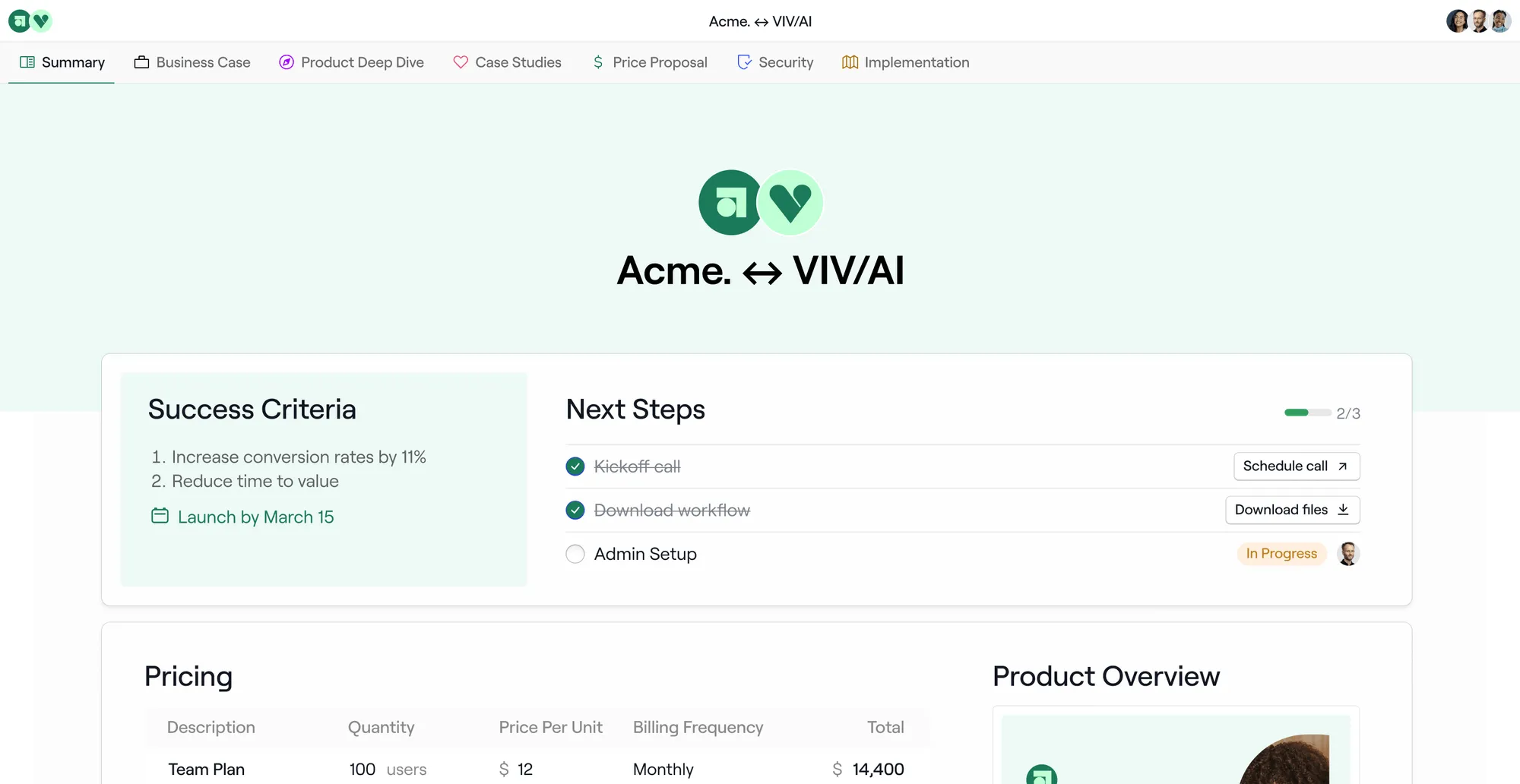
Dock is an AI revenue enablement platform that keeps every stage of the customer journey in one workspace. It covers content management, rep guidance, buyer collaboration, onboarding and learning, and is lighter to roll out than Seismic or Highspot.
What are Dock's key features?
- Connected workspaces: One link follows the customer from intro call through onboarding to renewal, so Sales and Customer Success share context.
- AI Documents: Generates business cases, onboarding summaries and meeting recaps from CRM data and call transcripts from Gong, Zoom, Fathom and Chorus.
- AI Enablement Agent: Answers deal questions, retrieves assets and summarizes calls inside the workflow.
- Content, playbooks and courses: A searchable library that recommends assets by persona and deal stage, plus playbooks and courses for reps or customer portals.
Where does Dock fall short?
- It is not the right fit for large enterprises that need advanced certification workflows or heavy CPQ.
- Advanced CRM features, such as custom fields and line items, require the Premium plan.
- Standard includes only 5 seats, and extra seats cost $50 per month.
Should you use Dock for sales enablement?
Choose Dock if you are a B2B SaaS revenue team that wants lifecycle coverage without a long implementation. Large enterprises with certification or CPQ needs will outgrow it.
More tools teams use alongside these
These tools turn up in enablement stacks but cover narrower jobs, so each gets one line.
- Loom: Screen and webcam videos for follow-ups and internal updates, with viewer analytics.
- Vidyard: Personalized video messages and video landing pages for warm outreach.
- Salesloft: Sales engagement platform in the same space as Outreach, with quote-only pricing.
- Apollo: Tools like Apollo pair a contact database with email sequences for prospecting.
- Clay: Data enrichment and workflow automation for building lead lists from several sources.
- ZoomInfo: B2B contact and company data with intent signals.
- Pipedrive: Visual pipeline CRM for small teams.
- Attio: Flexible CRM with custom objects and workflows.
How did we pick the best sales enablement software?
We did not try to list every tool. We picked the tools that Google and AI answers keep naming for this topic, plus Supademo, our own buyer-facing demo tool, and sorted them by the job each one does.
Each entry covers what the tool does, what it costs, where it falls short and who should skip it. We compared them on four things: how easy they are to adopt, what they can actually do, price transparency, and how well they connect to the rest of your stack.
Ease of use
Reps will not use a tool that is hard to learn. HubSpot and Pipedrive stand out for intuitive interfaces and quick setup, and the less training a tool needs, the sooner your team sees results.
Features and functionality
Features decide how well a tool solves your team's actual problem. Supademo, for example, offers interactive demo creation and analytics.
Pricing and value
Price should match the value a tool brings to your sales process. Many platforms here are quote-only, so each entry says whether pricing is published.
Integration capabilities
Your stack only works if the tools connect, so we looked at integrations with CRMs, email platforms and marketing tools.
Outreach, for example, connects with CRMs like Salesforce so prospect data stays current across systems. Supademo syncs with HubSpot, Salesforce and Marketo and publishes demos into Seismic.
What are essential features to look for in sales enablement software?
Look for these five capabilities when you shortlist a tool.
1. Content management
Reps need quick access to case studies, pitch decks and pricing documents. Highspot, for example, offers a central library plus insight into which content works best.
2. Interactive demo creation
Product demos often decide deals. Tools like Supademo let you build interactive product tours that show value without a live walkthrough. A demo hub and demo videos help SaaS teams scale demos and share them asynchronously with global audiences.
3. Automation and personalization
Automating follow-ups and reminders saves time, and personalization keeps outreach relevant. Outreach, for example, automates email sequences while keeping them personal.
4. Analytics and reporting
Analytics show which content and outreach work. Seismic, for example, reports on content usage and engagement so you can focus on high-performing assets.
5. CRM integrations
A tool that integrates with CRMs like Salesforce or HubSpot keeps data consistent and removes manual updates, so reps spend their time selling.
Final thoughts: what is the best sales enablement solution of 2026?
There is no single best tool, because sales enablement covers several jobs. Match the tool to the gap you have:
- Content sprawl and rep training at enterprise scale: Seismic or Highspot, which are now one company.
- Field and mobile selling: Showpad.
- Slow ramp and uneven skills: Mindtickle or Allego.
- Coaching from real calls: Gong.
- Buyers who want to see the product before a call: Supademo, alongside whichever platform you choose.
- Deal rooms and shared workspaces: Flowla or Dock.
Best sales enablement software—where to start?
Start with the gap that costs you the most deals, shortlist one platform for it, and add point tools only where a job is still uncovered.
Want buyers to explore your product before the first call? Try Supademo for free and build your first interactive demo in minutes.
Frequently asked questions about sales enablement tools
Commonly asked questions about this topic.
What are sales enablement tools?
What is the difference between sales enablement and sales engagement tools?
How much do sales enablement tools cost?
Which sales enablement tool is best for a small SaaS team?
Do sales enablement platforms include product demos?
How does Supademo work with Seismic?
What changed when Seismic merged with Highspot?
Related tools: AI Sales Script Generator · AI Sales Pitch Generator

Content Writer
Prit is a Freelance Content Writer at Supademo with 5+ years of expertise in B2B SaaS content, helping multiple brands grow online. When not writing, he enjoys reading books with a cup of coffee.