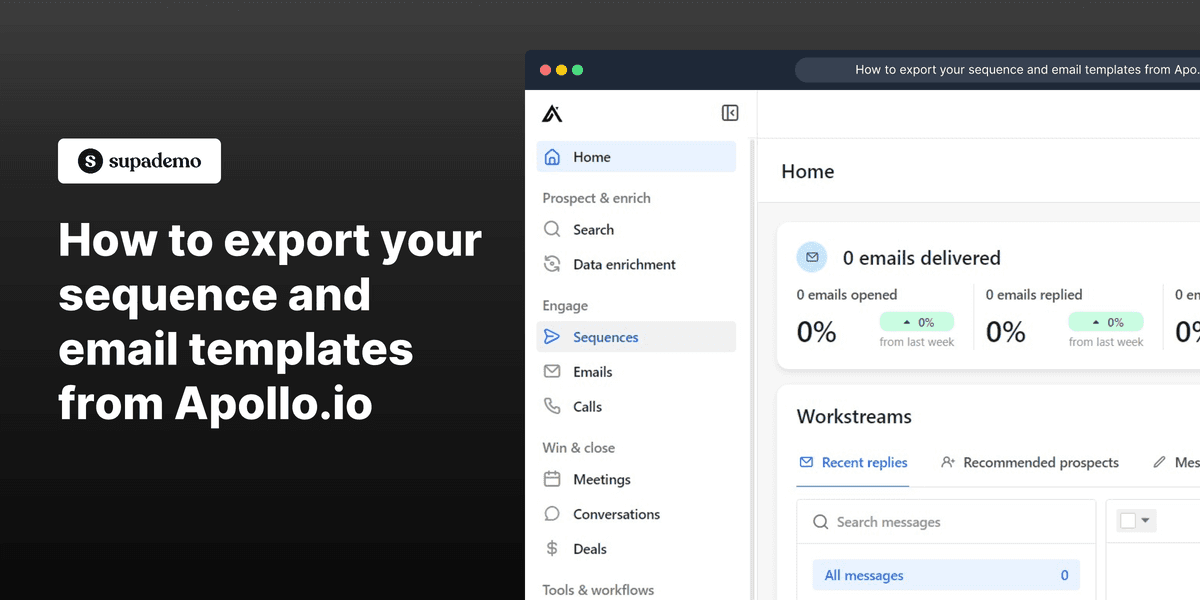
Interactive Apollo.io Demo
Explore an interactive product demo of Apollo.io, a comprehensive sales intelligence and engagement platform designed to help sales teams find, engage, and convert prospects.
What is Apollo.io?
Apollo.io is a sales intelligence and engagement platform that combines a B2B contact database with outbound email sequencing, dialing, and LinkedIn automation in one tool. Founded in 2015, Apollo has grown rapidly to serve over 1 million users — primarily sales development reps (SDRs) and account executives doing outbound prospecting.
Apollo's database includes over 275 million contacts and 60 million companies with verified email addresses, direct dials, and firmographic data. Unlike pure data tools (like ZoomInfo), Apollo also includes a full sales engagement platform — sequences, call recording, A/B testing, and performance analytics.
Apollo's pricing model makes it significantly more accessible than competitors like ZoomInfo: a generous free tier with 50 email credits/month and paid plans starting at $49/user/month include both the data and the engagement tools.
How to get started with Apollo.io
- 1
Create your free account
Sign up at apollo.io — the free plan includes 50 email credits and 5 phone credits per month, plus access to the full contact database for searching. Paid plans start at $49/user/month for unlimited sequences.
- 2
Build your prospect list
Use Apollo's People search to filter by job title, company size, industry, location, and technology stack. Save results to a list. Export to your CRM or manage prospects entirely within Apollo.
- 3
Create an email sequence
Build a multi-step sequence with emails, LinkedIn steps, and call tasks. Write or use AI-assisted copy for each email. Set delays between steps (e.g. email day 1, LinkedIn connection day 3, call day 5).
- 4
Enroll prospects in sequences
Select prospects from your list and enroll them in a sequence. Apollo personalizes emails with merge variables (first name, company, title). Set daily sending limits and sending schedule.
- 5
Track and optimize performance
Monitor sequence analytics: open rates, reply rates, click rates, and booked meetings by step. A/B test subject lines and email copy. Pause sequences for prospects who reply or book meetings automatically.
Explore more Apollo.io guides
Step-by-step interactive demos and tutorials for Apollo.io.

Who is Apollo most useful for?
SDRs and sales reps doing outbound prospecting who need both B2B contact data and an email sequencing tool in one platform. Use Supademo to create interactive guides of your Apollo workflow — showing new reps how to build prospect lists, enroll them in sequences, and track engagement metrics.
Startup and SMB sales teams that want a ZoomInfo-alternative without the enterprise price tag. Pair Supademo product demos with Apollo email sequences — embed interactive demo links in your outreach emails so prospects can self-explore before your first call.
Growth teams testing outbound channels and building scalable GTM motions. Create Supademo walkthroughs of your best-performing outreach sequences so the whole team can replicate successful approaches.
RevOps teams managing data quality, sequence performance, and outbound analytics. Build Supademo guides of your Apollo configuration for onboarding new SDRs to your sales stack.
Looking for alternatives to Apollo.io?
Here are four tools worth evaluating depending on your needs.
More comprehensive data with better direct dial coverage and intent signals. Much more expensive. ZoomInfo is for enterprise; Apollo is better for SMBs and high-velocity SDR teams.
View demo →
More powerful for large enterprise sales teams with advanced analytics and forecasting. Less data included — requires a separate data source. Apollo is more all-in-one.
Better for enterprise cadences with advanced analytics and Salesforce integration. No database included. Apollo is better for teams wanting data and engagement in one tool.
Better for finding individual contact details while browsing LinkedIn. Simpler and cheaper. Apollo is better when you need both data and a full sequencing platform.
FAQs on Apollo.io
Commonly asked questions about Apollo.io. Have more? Reach out and our team will be happy to help.
Yes. Apollo's free plan includes 50 email credits, 5 phone credits, and 5 export credits per month, plus unlimited email sequences (up to 250 emails/day). Paid plans from $49/user/month add unlimited credits and advanced features.
Apollo's email accuracy is generally good for business emails, with built-in email verification. Phone numbers (especially mobile/direct dials) are less comprehensive than ZoomInfo. Apollo's data is contributed by users and verified by their own database.
Yes. Apollo's Salesforce integration syncs contacts, accounts, activities, and sequence enrollment bi-directionally. It auto-creates or matches CRM records when prospects are enrolled in sequences.
Apollo sequences are automated multi-step outreach campaigns. You define a series of steps (email, LinkedIn, call) with delays between them. Apollo sends emails automatically on schedule, pauses for replies, and logs all activity.
Yes. Apollo's Chrome extension integrates with LinkedIn to automate connection requests and LinkedIn messages as steps within sequences. This requires the Apollo Chrome extension and a LinkedIn Sales Navigator account.
Yes. Apollo includes a built-in power dialer that calls prospects directly from the platform, logs call outcomes and notes, and records calls (with permission). Call transcription is available on higher plans.