Onboarding Snapshot
Activation Event
First recording started from the in-browser recorder
Time-to-Value
~6–9 minutes
Primary Strength
Uses its own product to teach the product
Primary Risk
Non-skippable personalization steps slow users before any recording
Overview
Tella is a browser-native screen recording and video tutorial tool that shows you what the product makes before you've made anything — using the product itself to do the showing. The onboarding dashboard gives users a clear choice between watching tutorials or jumping straight to recording, respecting different confidence levels from the start. The main friction is a pre-dashboard sequence of personalization steps without skip options that delays the activation moment for users who want to record immediately.
What Should You Steal?
Swipe through actionable takeaways from this onboarding flow.
How Tella Uses Its Own Product as the Tutorial
The tutorial video shown inside the dashboard is recorded using Tella itself.
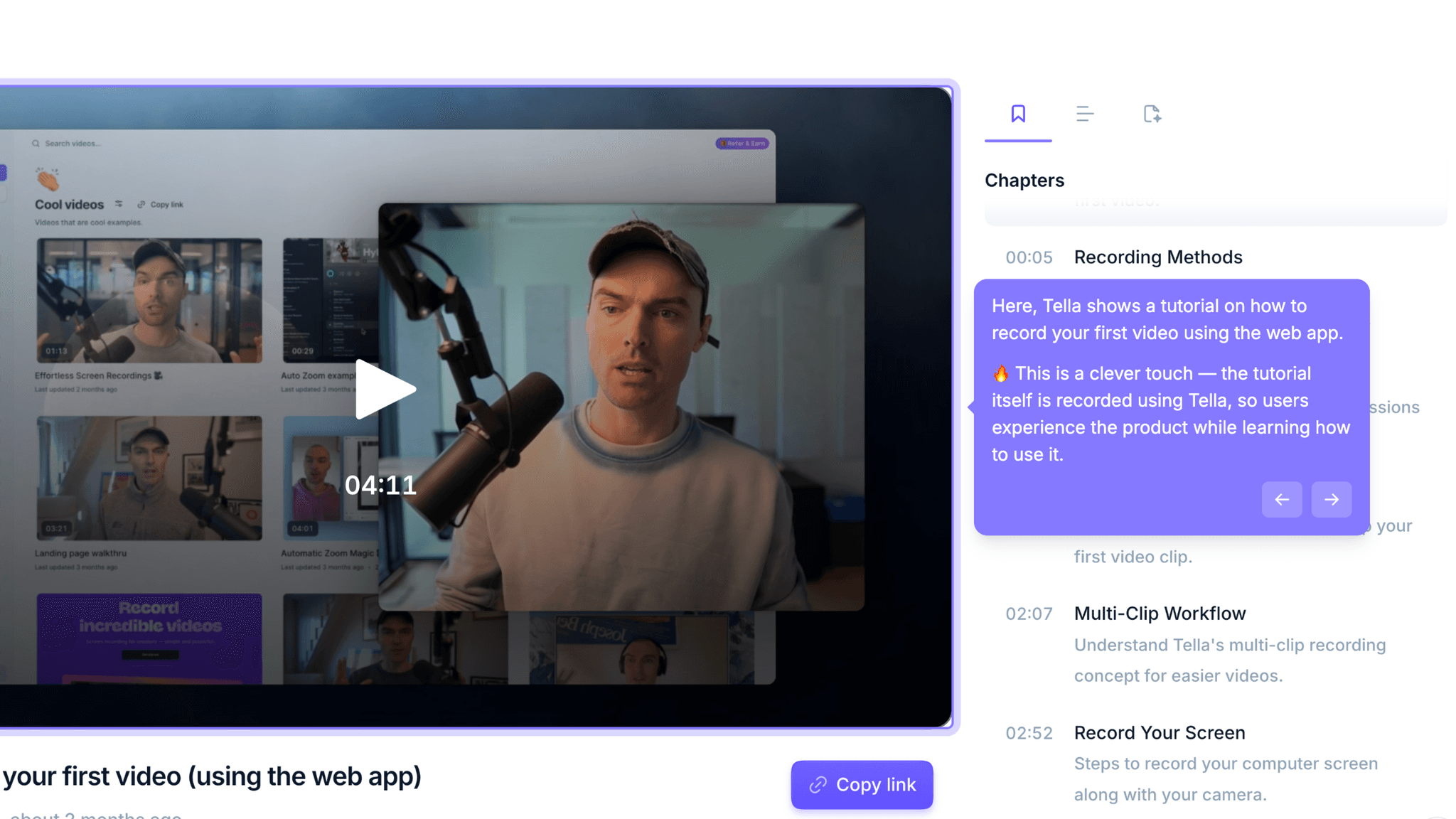
I'm watching Tella-produced content to learn how to use Tella — no fanfare, no label saying 'made with our product.' It's just a tutorial that happens to prove the product works. Most SaaS tools teach through documentation or a walkthrough layer that lives outside the product. Tella collapses those two things. The teaching artifact is also the product artifact. Show your own output as the first thing people encounter and you skip a layer of explanation entirely.
How Tella Separates Learning from Doing
Tella's dashboard gives users a choice:
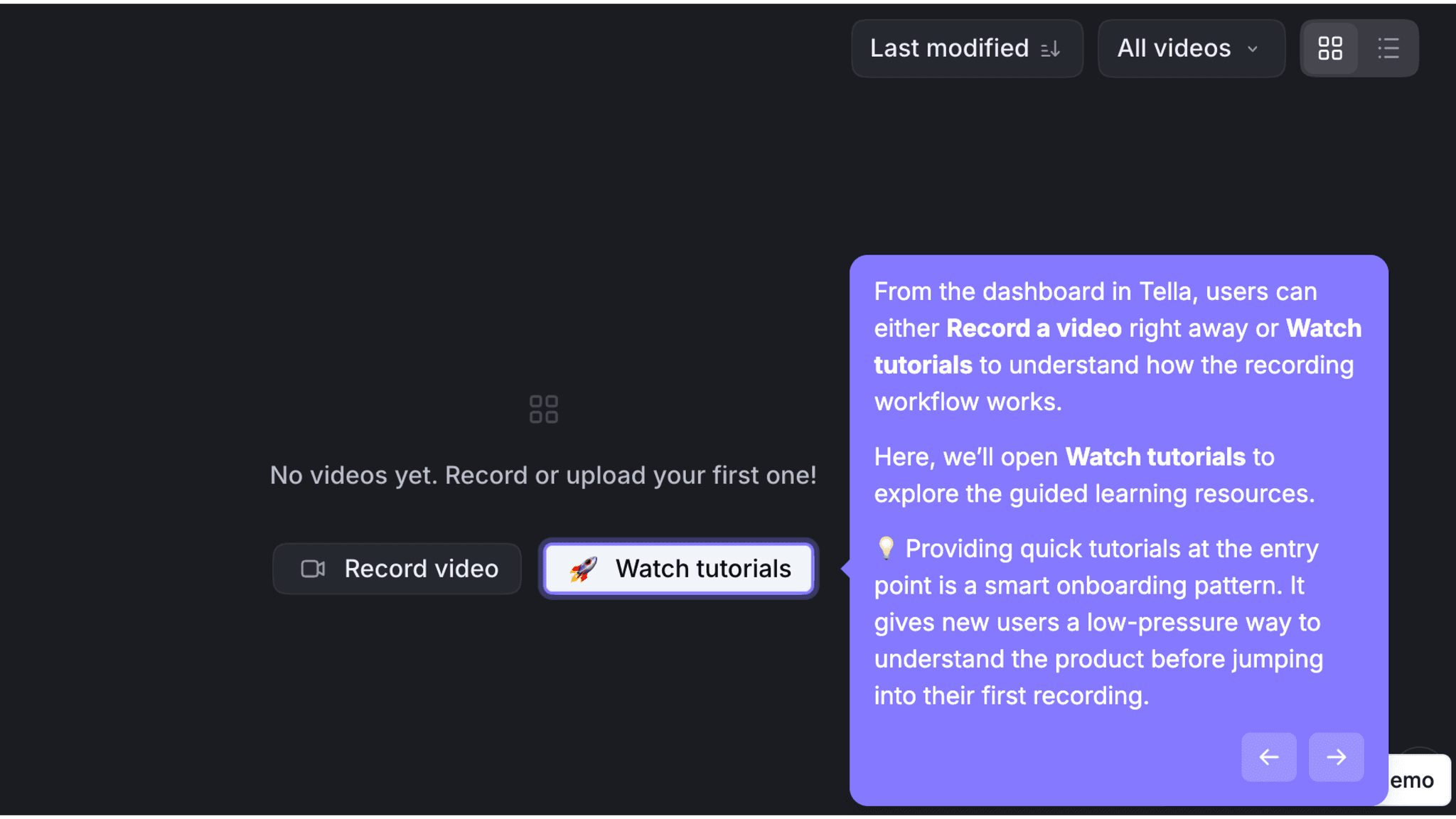
Watch tutorials on one side, Record on the other. They're distinct options, not a forced sequence. That matters because people arrive with different confidence levels — someone who's never done screen recording wants the tutorial, someone switching from Loom doesn't. Tella doesn't force them through the same path. The two-option structure respects that people already know what they need.
Onboarding Tactics That Work
Tutorial content recorded in Tella itself demonstrates output quality before first recording
Dual dashboard entry — Watch tutorials or Record — lets users self-select their confidence path
7-day free trial with 'no credit card required' clearly stated reduces commitment anxiety at the gate
Where There's Friction
Several personalization steps (role, referral source, creator name) lack a skip option
Permission flow for camera and microphone adds steps immediately before the first recording moment
Some users who want to jump straight to recording are slowed by mandatory segmentation
When Is the In-App Activation Moment?
The activation moment in Tella is pressing Record and starting the first video. Not watching the tutorial, not selecting a role, not enabling permissions. Actually beginning to capture.
Getting there takes 6–9 minutes, and most of that time sits in steps you complete before you've seen anything the product makes. Account creation, role selection, referral attribution, creator attribution if applicable, optional teammate invite. Each one is a single screen with a single question, so none of them feel heavy on their own. They pile up before I've had a reason to care about any of it.
The part worth paying attention to: several of these steps don't offer a skip. For anyone who wants to evaluate the recording experience first and answer questions later, that's not a minor inconvenience. It's the most concrete friction in the flow.
Once past the pre-dashboard steps, the experience holds together well. The dashboard immediately presents the Watch / Record choice. The tutorial is a real Tella recording, not a help doc. Record launches the browser-based recorder after a one-time permission grant. But for anyone who has never granted camera and microphone access in their browser before, the experience goes from 'click Record' to 'configure permissions' before anything is captured.
The Bottom Line on Tella's Onboarding
Tella does something genuinely clever: it shows you what the product makes before you've made anything, and it uses the product itself to do the showing. Watching a Tella-produced tutorial inside the Tella dashboard removes a layer of abstract marketing and replaces it with direct evidence. That's not a common pattern, and it earns the flow a lot of goodwill early.
The honest critique is the pre-dashboard sequence. A handful of personalization questions without skip options is not a serious problem on paper. In practice it slows the exact people most likely to churn early: the impatient ones who want to press record immediately.
Tella's own insight is that getting people to record fast is the goal. The steps that precede recording quietly work against it.
Steal the self-demonstrating tutorial. If your product makes anything, use it to make the tutorial that teaches people how to use it.
FAQs
Common questions about Tella's onboarding flow and what makes it effective.
How does Tella onboard new users?
Tella's onboarding runs through account creation, role selection, referral attribution, and an optional teammate invite before landing on a dashboard with two clear entry points: Watch tutorials or Record. The tutorials are recorded using Tella itself. From the dashboard, users can start a browser-based recording after granting camera and microphone permissions. The full flow from signup to first recording takes approximately 6–9 minutes.
What makes Tella's onboarding stand out?
The tutorial content. Tella's guided learning resources are actual recordings made with Tella, which means users experience the product's output quality before creating anything. Most screen recording tools explain the product through documentation or a separate help layer. Tella collapses the teaching and the demonstration into the same artifact, which makes for a cleaner and more credible introduction to what the product does.
How long does it take to reach value in Tella?
Approximately 6–9 minutes from signup to first recording started. The pre-dashboard personalization steps make up most of that time, and several can't be skipped. Once inside the dashboard, the path from Watch tutorials to Record to first capture is short. Compressing the pre-dashboard steps or adding skip options to the non-essential ones would bring Tella's Time-to-Value closer to the 3–5 minute range of tools like VEED and Supercut.
How does Tella's onboarding compare to other SaaS tools?
Tella's self-demonstrating tutorial is a distinct move in the screen recording category. Supercut uses example videos in the workspace to set expectations for output quality, which is the same underlying principle: show the product's work before the person has done any. Where Tella differs is that the examples aren't static screenshots or pre-made samples, they're live recordings made with the same tool.