How Bullhorn accelerates training and documentation with interactive demos
Discover how Bullhorn's Instructional Design and Product Documentation teams replaced videos with interactive demos, increasing learner engagement by 20%.
50%
Course-creation time reduction
20%
Lift in demo engagement
Zero
Dev / design resources required
- Company size
- 1,400 employees (14 countries)
- Use Cases
- eLearning, LMS training, knowledge base, scenario-based simulations
- Challenges
- Slow video production, passive learning, high maintenance effort
- Outcomes
- 50% faster course creation, 20% higher engagement, zero design or engineering dependency

"Supademo helps us meet customers where they are, delivering quick, clear, and interactive training that saves us hours of production time."

About Bullhorn
Bullhorn, a global leader in staffing and recruitment software, cut production time and improved learner engagement by replacing traditional video-based walkthroughs with interactive demos from Supademo. Today, their Instructional Design and Product Documentation teams use Supademo to deliver clear, engaging, and always up-to-date product training without relying on design or engineering support.
What is Bullhorn?
For the past 25 years, Bullhorn has dedicated itself to building industry-leading, cloud-based software for the staffing and recruitment industry. Through partnerships with 10,000 customers globally, Bullhorn has built a vast knowledge base of recruitment best practices and deep domain expertise to help firms scale their businesses. Founder-led and headquartered in Boston, Bullhorn employs 1,400 people across 14 countries focused on delivering an incredible customer experience – its core mission.
Competing with platforms like Avionté, JobAdder, and Vincere, Bullhorn stands out for its end-to-end process coverage, deep automation, and industry-specific focus. With AI infused throughout its platform and decades of domain expertise, Bullhorn remains founder-led since 1999 and is trusted by both boutique agencies and global staffing leaders alike.
What challenges did Bullhorn face before Supademo?
Bullhorn's Instructional Design team needed a faster, more scalable way to build product training content. Their existing approach, relying on screen-recorded videos and static screenshots, slowed down production and made it harder for learners to stay engaged. The team needed a more efficient way to build product training content.
Video-based learning bottlenecks
- High production effort: Storyboarding, animating, editing, and SCORM uploads could take days.
- Limited agility: Updates required editing existing content, potentially re-recording voiceovers, resyncing audio and captions, and republishing the SCORM file to re-upload to the LMS.
- Passive experience: Screenshots and videos couldn't guide users or simulate product interaction.
- Resource dependency: Designers and developers were often needed to build, maintain, and update content.
To modernize their approach, Bullhorn needed a lightweight, flexible solution that could deliver hands-on training, without the overhead of traditional tools.
Why did Bullhorn choose Supademo as their demo automation solution?
Bullhorn had previously used video editing software to build click-through guides, but the process was time-consuming and not easily scalable. When evaluating interactive demo tools, they prioritized speed, ease of use, and cross-platform flexibility.
Their key criteria included:
- Clean, no-code creation for fast demo production and easy updates
- Flexible embedding into Rise 360 courses, which are then published as SCORM and uploaded to the LMS
- Automatic click recording and generation of text annotations to remove manual editing
- Interactive experiences that felt more dynamic than static video
Supademo stood out for delivering all of the above while reducing production time from days to hours and empowering teams to work independently.
How does Bullhorn use Supademo?
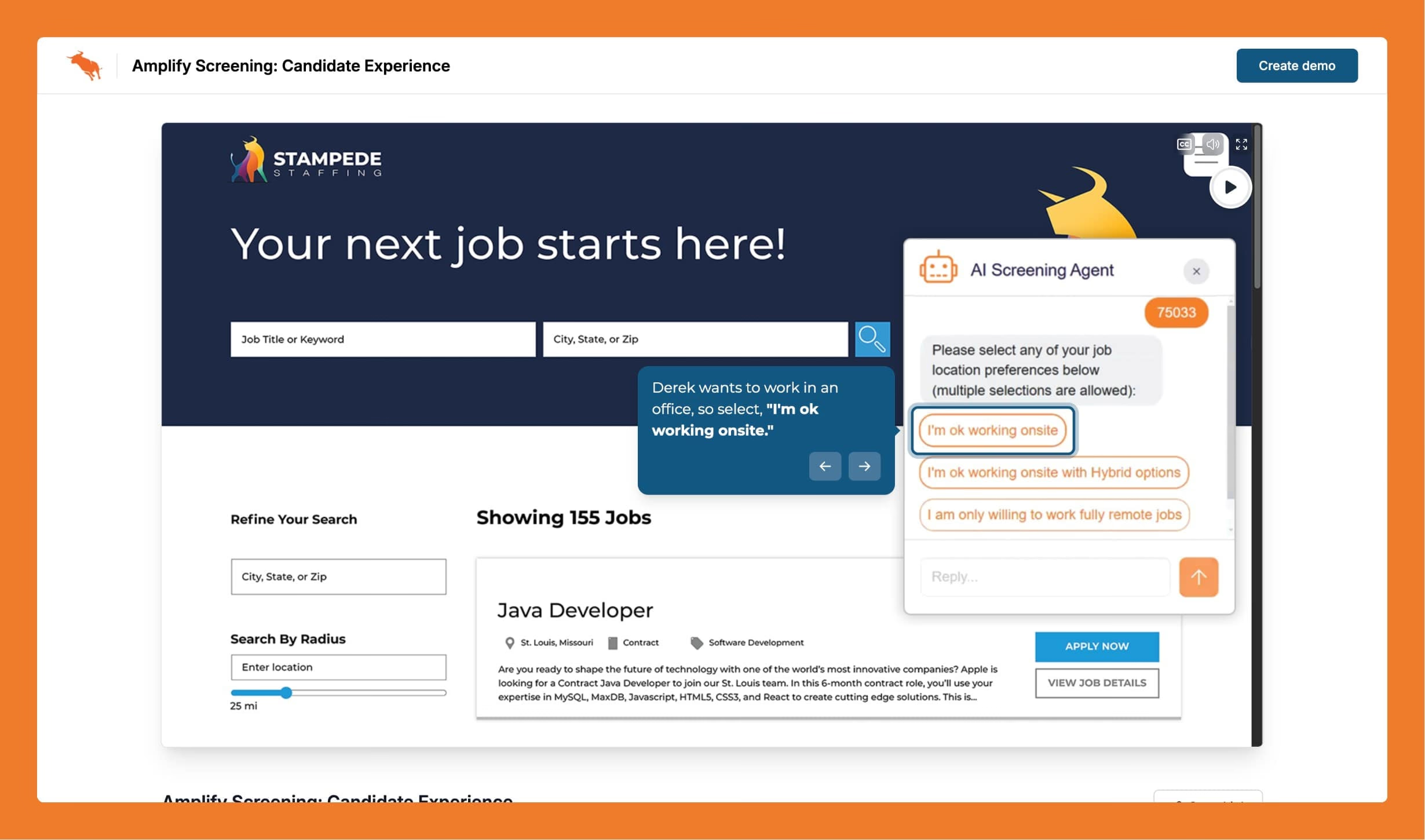
Bullhorn now uses Supademo across its Instructional Design and Product Documentation teams to support internal and customer-facing education. The platform powers eLearning modules, help center content, and interactive training guides.
eLearning and LMS training
Bullhorn's Instructional Design team uses Supademo as their primary employee training tool for building scalable, repeatable training across global teams.
- Embed Supademos into Rise 360 courses to give users a hands-on walkthrough
- Replace passive video with clickable experiences for key workflows
- Layer in AI voiceovers to support auditory learners
- Combine Supademos with video clips and transitions for a polished experience
Product documentation
- Add step-by-step demos to knowledge base articles
- Reduce reliance on screenshots and static GIFs
- Enable faster updates without re-exporting courseware
HTML interactive demos and sandbox demo environments
- Use HTML recording to simulate test data and add realism
- Plan to explore sandbox-style learning paths in future curriculum design
- Evaluation of Supademo for scenario-based training simulations beyond current tooling
By centralizing demo creation in Supademo, Bullhorn is able to create more engaging learning content faster, without sacrificing clarity or quality.
What results has Bullhorn achieved with Supademo?
Since adopting Supademo, Bullhorn has dramatically reduced content production time while increasing internal flexibility and learner satisfaction.
"Publishing courses in under two weeks, down from a month, was only possible once we switched to Supademo."
Time & workflow efficiency
50% reduction in course-creation time since introducing Supademo. Hours saved per demo compared to video editing and re-uploading.
Immediate updates allow content to stay current without LMS delays.
No dev/design support needed, empowering instructional teams to work autonomously.
In late 2024, Bullhorn shifted from producing video-only training courses to a more flexible, multimedia approach using Rise 360, just as they began using Supademo. Previously, course creation could take up to a month. With Supademo and Rise 360 combined, courses are now published in under two weeks. Supademo played a key role by simplifying content creation, reducing production effort, and making training more interactive and engaging.
Improved learning outcomes
~20% increase in demo engagement since March, based on Supademo analytics
Multi-modal learning: Visual, interactive, and auditory formats in a single asset
Higher engagement: Learners are more likely to complete workflows they can try
Faster time to value: New users understand the product faster and with less support
Internal adoption and stakeholder trust
Supademos are now standard in self-paced training and help documentation
Reduced headaches across content teams with simplified workflows
Positive feedback from both internal teams and customers
| Before Supademo | After Supademo |
|---|---|
| Video editing + screen recording | Interactive demo creation in minutes |
| Full re-uploads to LMS | Instant updates with no re-publishing |
| Passive watching | Click-through, guided experiences |
| Designer & developer dependency | Fully owned by Instructional Design and Doc teams |
What's next?
Bullhorn is now exploring Supademo's HTML demo and sandbox capabilities to simulate deeper user scenarios and add more personalized training flows. One promising idea: building scenario-based learning interactions directly inside courses, going beyond the limitations of their current tools.
As they continue to scale globally, Supademo is becoming a core part of Bullhorn's learning and enablement stack.