Free CAC Calculator
Calculate customer acquisition cost, CAC payback period, and LTV:CAC ratio with a simple SaaS calculator built for sales and marketing teams.
Customer Acquisition Cost
= (Sales + Marketing) ÷ New Customers
Total spend
$65,000
CAC payback
6.8 mo
LTV:CAC
8.3:1
How interactive demos reduce your CAC
- 28% average CAC reduction reported by Supademo customers
- RB2B eliminated 61 hours of sales calls in their first 30 days
Trusted by 200,000+ top operators and 3,000+ paying organizations


How to calculate customer acquisition cost
1. Add acquisition spend
Enter your monthly sales and marketing costs for the period you want to analyze.
2. Enter new customers
Add the number of new customers acquired in that same period so CAC stays apples-to-apples.
3. Review CAC and payback
Use optional ARPU, gross margin, and LTV inputs to see payback period and LTV:CAC ratio.
Why use our CAC calculator
Clear CAC formula
See customer acquisition cost using the standard sales plus marketing spend divided by new customers formula.
Payback context
Layer in ARPU and gross margin to understand how long each new customer takes to pay back.
LTV:CAC visibility
Add LTV to compare acquisition cost against customer lifetime value and spot efficiency gaps.
Why we built Supademo's CAC calculator

“Most CAC waste comes from buyers who never understood the product before talking to a salesperson. ProcessMaker lifted lead generation 15% after giving prospects a self-serve walkthrough first. CAC dropped on the same spend.”

“Most teams I talk to are paying twice for acquisition: ads to get the click, then a salesperson to re-explain the product. Our State of Interactive Demos 2026 report found 78% of teams now use demos across two or more use cases for exactly this reason.”
Who uses Supademo's CAC calculator?
Understand the cost behind every new customer
Compare sales effort, demo volume, and acquisition cost so reps can focus on opportunities that convert efficiently.
Explore sales enablement
Measure campaign efficiency beyond leads
Turn spend and customer volume into a simple CAC benchmark for paid, content, event, and product-led campaigns.
Explore product marketing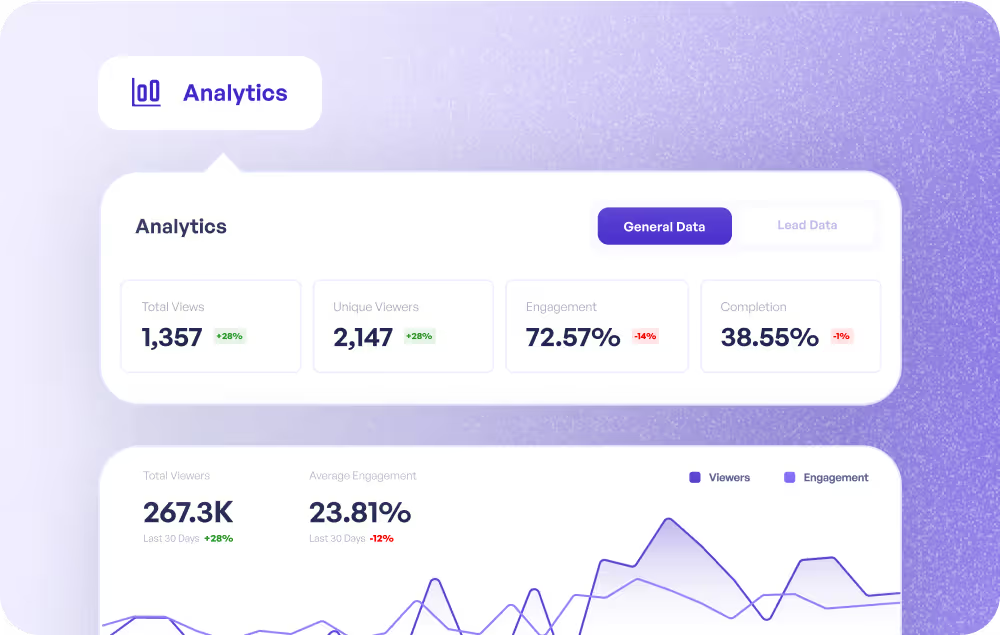
Connect acquisition quality to retention
Compare CAC against payback and LTV to understand whether new customer segments are likely to create durable growth.
Explore customer success
Reduce repetitive pre-sale education
Identify where better self-serve education can lower acquisition costs and prevent basic questions from becoming sales bottlenecks.
Explore customer support
Prioritize experiences that improve efficiency
Use CAC trends to spot where onboarding, activation, and product education can make acquisition more profitable.
Explore product use cases
Train GTM teams on acquisition economics
Help new reps and marketers understand how spend, conversion, ARPU, and margin shape efficient growth.
Explore training use cases
How do sales teams use a CAC calculator?
Sales teams use CAC calculators to connect sales effort and acquisition spend to the number of new customers won.
How do marketing teams use a CAC calculator?
Marketing teams use CAC calculators to evaluate how efficiently campaign spend turns into paying customers.
How does customer success use CAC?
Customer success teams use CAC with LTV and payback to understand whether acquired customers are likely to become profitable long-term accounts.
How can support teams affect CAC?
Support teams can reduce CAC by creating reusable answers and guides that help prospects and customers self-serve.
How do product teams use CAC?
Product teams use CAC to understand where product-led education and activation can improve acquisition efficiency.
How do training teams use a CAC calculator?
Training teams use CAC calculators to teach acquisition economics with concrete sales and marketing inputs.
Explore Similar Free Tools
Frequently asked questions
Common questions about customer acquisition cost, payback period, and improving CAC with interactive demos.

Customer acquisition cost (CAC) is the total sales and marketing spend required to win one new customer during a given period. Most teams undercount it because they exclude tooling, agency fees, or the loaded cost of sales and marketing headcount.
A realistic CAC picture should include every dollar that touched the acquisition process, not just media and events. For a deeper walkthrough of channel-level CAC tracking and benchmarks, see our guide to customer acquisition strategy.
Add all sales costs and marketing costs for a period, then divide by the number of new customers acquired in that same period. The most common mistake is mismatching the time window: spending this month often closes customers next month, which can make CAC look artificially high in high-growth phases.
Using a trailing three-month or rolling average smooths those timing gaps. This calculator keeps the formula clean. You set the period, you match the inputs.
Include paid media, content production, events, tools and software subscriptions, outbound sequences, agency and contractor fees, and the fully-loaded compensation of everyone in sales and marketing. The most often overlooked items are sales engineer time, demo environments, and the cost of free trials.
Excluding these routinely understates true CAC by 20–40% for teams with complex sales motions. Most investors and operators benchmark against fully-loaded CAC, so it is worth building the habit early.
Many SaaS benchmarks cite 12 months as the target, but the right payback period depends heavily on your gross margin, expansion motion, and how early customers start paying full price. A 12-month payback at 40% gross margin is much harder to sustain than 18 months at 80% gross margin.
High-velocity PLG teams often need payback under 6 months to fund growth without heavy external capital, while enterprise teams with strong NRR can tolerate 24 months. Use the payback field here alongside your LTV calculator to see the full picture.
CAC payback measures how many months of gross profit it takes to recover what you spent to acquire a customer. If your gross margin is 80%, only 80 cents of every ARPU dollar goes toward recovering that cost. The rest goes to cost of goods.
A lower gross margin means recovery takes longer even if ARPU stays the same. This is why comparing CAC across SaaS and services companies is misleading without normalizing for gross margin first.
LTV:CAC compares how much value a customer generates over their lifetime against what it cost to acquire them. A ratio of 3:1 is the most-cited SaaS benchmark, but it is a starting point, not a rule.
Early-stage companies in fast-growing markets sometimes run 2:1 deliberately to fund expansion. More mature companies often target 5:1 or higher.
The ratio only makes sense alongside retention rate and NRR. A high ratio with a short average contract length is not the same as one with strong multi-year retention.
Interactive demos let prospects self-qualify and experience product value before they ever talk to a rep, which compresses the sales cycle and reduces the number of discovery calls needed per closed deal. Supademo customers report an average 28% reduction in CAC after deploying demos across their website, outbound sequences, and paid campaigns.
RB2B eliminated 61 hours of sales calls in their first 30 days by replacing manual demos with automated product experiences. If the biggest driver of your CAC is sales headcount and long cycles, self-serve product education is often the highest-leverage lever.
See how teams deploy demos across the funnel at sales enablement use cases.
Yes. Supademo's CAC calculator is completely free and runs entirely in your browser. Nothing is stored or sent to any server. No sign-up required.