Sales Win Rate Calculator
Free sales win rate calculator for B2B sales teams. Calculate opportunity win rate, current pipeline revenue, and the revenue impact of improving conversion by five percentage points. (Not for sports or trading.)
Sales Win Rate
= Closed Won ÷ Total Opportunities × 100
At +5% win rate
35.0%
Revenue impact
$34,000
Current won revenue
$204,000
How interactive demos improve win rates
- 7x higher conversion rate vs. traditional demo videos
- beehiiv saw 50% of visitors convert after replacing static screenshots with interactive demos
Trusted by 200,000+ top operators and 3,000+ paying organizations


How to calculate sales win rate
1. Enter opportunities
Add the total qualified opportunities created or worked during your chosen period.
2. Add closed won deals
Enter how many of those opportunities became customers so the calculator can compute win rate.
3. Model revenue impact
Add average deal size to see won revenue and the upside from a five point win rate lift.
Why use our sales win rate calculator
Simple win rate math
Calculate closed won deals divided by total opportunities with clear invalid-state handling.
Revenue impact modeling
See how a five point win rate improvement changes revenue without increasing pipeline volume.
Pipeline context
Translate win rate into won revenue using your average deal size.
Why we built Supademo's win rate calculator

“Win rate moves when buyers can move on their own time. RB2B eliminated 60+ hours of sales calls in 30 days by sending interactive demos instead of booking a second meeting. Deal velocity went up at the same time.”

“Per our 2026 demos report, 62% of teams rate sales efficiency as a high or very high impact area for interactive demos. Small win-rate gains compound, and the easiest gains usually come from cutting steps the buyer didn't need.”
Who uses Supademo's win rate calculator?
Track conversion across your pipeline
Measure opportunity conversion and model how better demos, follow-ups, and champion enablement affect revenue.
Explore sales enablement
Compare lead sources by revenue quality
Use win rate with deal size to compare channels by revenue outcomes, not just lead volume.
Explore product marketing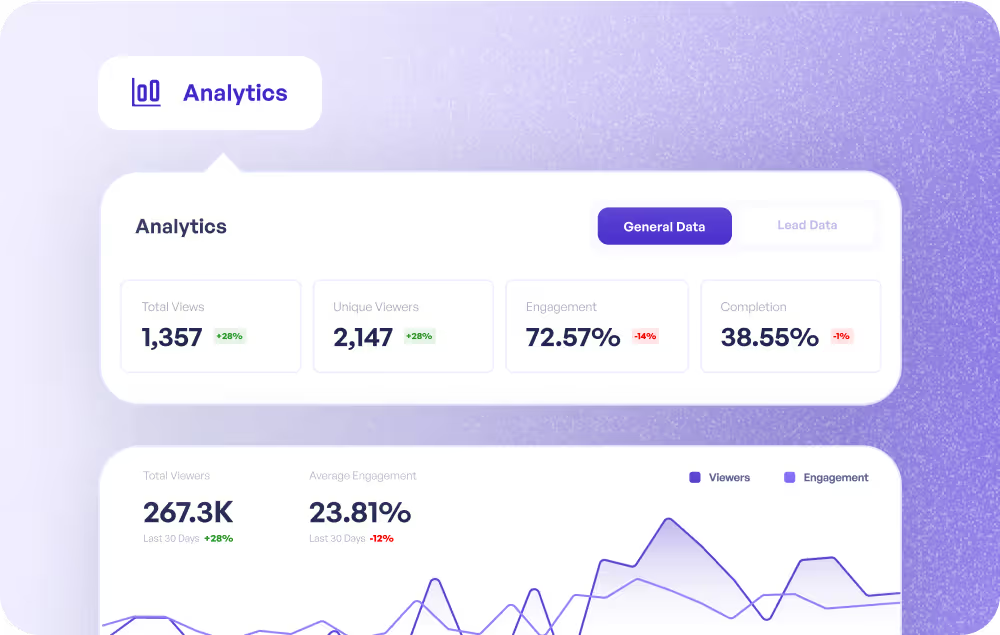
Spot expansion-ready segments
Pair win rate with customer quality signals to understand which segments are likely to retain and expand.
Explore customer success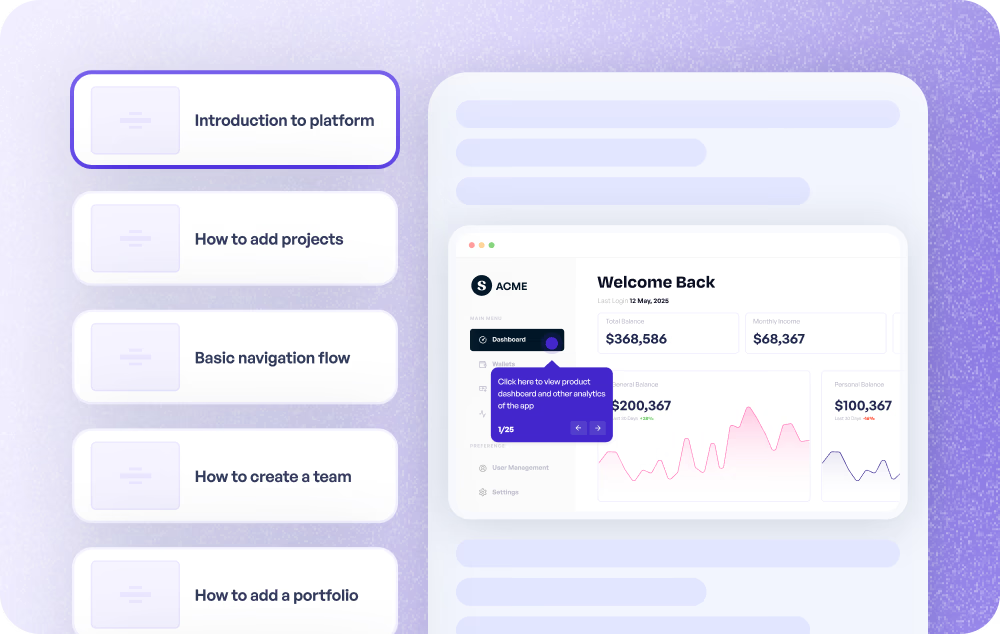
Reduce deal friction with better answers
Identify product questions that slow deals and turn them into reusable demos and support resources.
Explore customer support
Connect feature proof to conversion
Use win rate as one signal for whether launches, onboarding, and product education are helping prospects convert.
Explore product use cases
Coach reps on pipeline quality
Use calculator scenarios to train teams on conversion, deal size, and where better discovery or demos matter most.
Explore training use cases
How do sales teams use a win rate calculator?
Sales teams use win rate calculators to understand how many opportunities become customers and what conversion improvements are worth.
How do marketers use win rate?
Marketers use win rate to evaluate whether campaigns create opportunities that convert into real revenue.
Why does customer success care about win rate?
Customer success teams care about win rate because acquisition quality affects onboarding, retention, and expansion.
Can support content improve win rate?
Support content can improve win rate by answering common product questions before they slow down a deal.
How do product teams use win rate?
Product teams use win rate to understand whether product education and feature proof are helping prospects convert.
How do training teams use win rate?
Training teams use win rate to coach reps on pipeline quality and conversion levers.
Explore Similar Free Tools
Frequently asked questions
Common questions about win rate, pipeline revenue, and improving sales conversion with interactive demos.

Win rate is the percentage of qualified sales opportunities that result in a closed-won deal within a given period. It is one of the most sensitive indicators of how effectively your sales motion converts pipeline into revenue.
Small changes in win rate have an outsized impact: a move from 20% to 25% on 100 opportunities at $10K ACV is $50K in additional ARR without touching headcount or pipeline volume. Use this alongside the CAC calculator to see how win rate changes affect acquisition efficiency.
Divide the number of closed-won opportunities by total qualified opportunities in the same period, then multiply by 100. The definition of "qualified" is what most teams argue about. Some include every opportunity created, others only count those that reached a specific stage like demo or trial. Be consistent because switching methodologies mid-analysis makes trends meaningless. For competitive benchmarking, closed-won divided by (closed-won plus closed-lost) is the most common apples-to-apples comparison.
It depends on the question you are answering. Closed-won divided by all opportunities (including open) gives you an efficiency snapshot for the period.
Closed-won divided by (closed-won plus closed-lost) isolates your conversion among resolved opportunities, which is cleaner for competitive analysis and process improvement. Most revenue operations teams track both: the first metric is leading (reflects pipeline health) while the second is lagging (reflects outcome quality).
Neither tells you why you win or lose. That requires win/loss interviews and stage-by-stage funnel analysis.
Industry benchmarks range from 15–30% for outbound-sourced deals and 30–50% for inbound-sourced deals, but segment and deal size matter enormously. SMB teams closing $3K ACV often report win rates above 40%, while enterprise teams at $100K ACV sometimes run below 20% and still build a strong business.
More useful than a single benchmark is tracking win rate by source, persona, competitor, and deal size. For a structural view of where deals are leaking, see our breakdown of the SaaS sales funnel and how teams improve pipeline conversion with product demos at sales enablement use cases.
This calculator multiplies your closed-won deal count by average deal size to estimate the revenue generated from won opportunities in the period. It is a useful quick-check against your CRM's closed-won ARR, but note it does not account for multi-year contracts, discounts, or expansion revenue.
For full revenue modeling, pair this with your NRR calculator to factor in churn and expansion on top of new ARR.
The calculator applies a five percentage point improvement to your current win rate, estimates the additional won deals that would result from the same opportunity count, and multiplies the difference by your average deal size. This is a sensitivity analysis to help you see the revenue upside of modest win rate improvement.
At 100 opportunities and $15K ACV, a 5pp win rate gain is worth $75K in additional ARR. The compounding case for small, systematic improvements is usually stronger than chasing big pipeline volume increases.
Interactive demos reduce the number of low-intent prospects that consume sales cycles by letting buyers self-qualify before they reach a rep. When demos are shared as follow-ups, stakeholders who missed the live call can evaluate the product asynchronously, which reduces no-show risk and accelerates multi-threaded deal progression.
Supademo customers report that deals where prospects engaged with an interactive demo before the discovery call have meaningfully higher close rates because objections surface earlier. See how sales teams deploy product demos across the funnel at sales enablement use cases.
Yes. Supademo's win rate calculator is completely free to use in your browser. No sign-up is required.