Free Employee Turnover Calculator
Calculate the annual cost of employee turnover, employees lost per year, and cost per replacement with a simple turnover calculator built for HR and people teams.
Annual Turnover Cost
= Employees Lost × (Avg Salary × Replacement Cost %)
Employees lost/yr
36
Cost per lost employee
$37,500
Monthly cost
$112,500
How interactive demos reduce turnover costs
- 85% average time saved on onboarding content creation with Supademo
- RB2B eliminated 61 hours of repetitive calls in 30 days
Trusted by 200,000+ top operators and 3,000+ paying organizations


How to calculate employee turnover cost
1. Enter your workforce size and turnover rate
Add your total employee count and annual turnover rate percentage to calculate how many employees you lose per year.
2. Add salary and replacement cost
Enter average annual salary and replacement cost as a percentage of salary. Industry standard for knowledge workers is 50-150%.
3. Review annual and monthly cost
See your total annual turnover cost, cost per lost employee, and monthly cost broken down.
Why use our employee turnover calculator
Full turnover cost formula
Calculate annual turnover cost by combining employees lost per year with the full replacement cost per employee.
Cost per lost employee
See the individual replacement cost so you can compare against onboarding improvements and retention investments.
Monthly cost view
Convert the annual cost to a monthly figure to understand the ongoing financial impact of your current turnover rate.
Why we built Supademo's employee turnover calculator

“Most early-tenure departures come back to a slow ramp. Bullhorn cut course-creation time in half by moving training to interactive demos. New hires reach competence sooner, and the people who reach competence sooner tend to stay.”

“Per our State of Interactive Demos 2026 report, 81% of teams rate onboarding as the area where interactive demos have high or very high impact. Faster ramp shows up as lower 90-day churn before it shows up anywhere else.”
Who uses Supademo's employee turnover calculator?
Understand the cost of sales team attrition
Calculate turnover cost for your sales team to justify investments in ramp programs, onboarding tools, and sales enablement content.
Explore sales enablement
Quantify marketing team retention costs
Use turnover data to make the case for knowledge management tools and onboarding programs that keep marketing team members longer.
Explore product marketing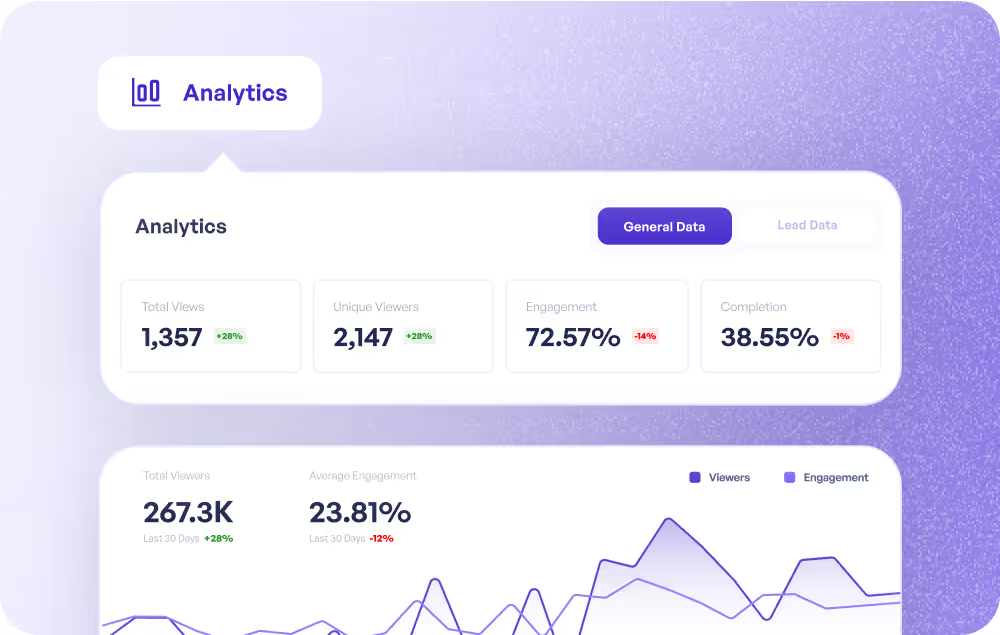
Reduce CS team turnover and ramp costs
Calculate the cost of customer success attrition to prioritize onboarding programs and tools that keep CSMs effective longer.
Explore customer success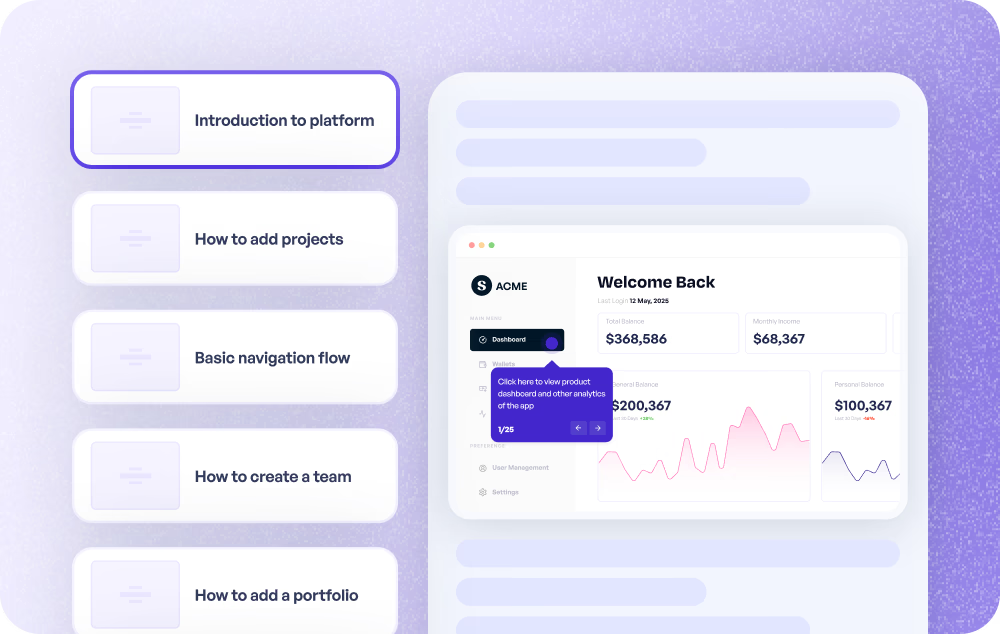
Reduce support team turnover costs
Quantify the cost of support team attrition to build the case for better onboarding, product training, and role clarity programs.
Explore customer support
Measure engineering and PM attrition cost
Calculate turnover costs for product and engineering roles to quantify the value of team stability and justify retention programs.
Explore product use cases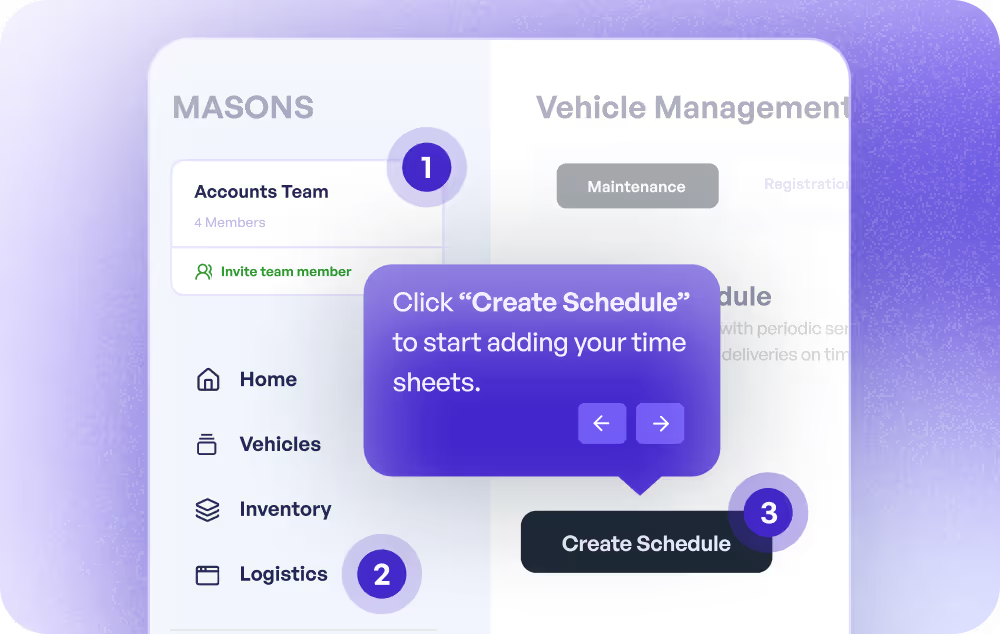
Build the business case for L&D investment
Use turnover cost data to quantify the ROI of training and onboarding programs that reduce early attrition across the organization.
Explore training use cases
How do sales teams use an employee turnover calculator?
Sales teams use turnover calculators to quantify the cost of rep attrition and justify investments in onboarding and ramp programs.
How do marketing teams use turnover cost data?
Marketing teams use turnover calculators to quantify attrition costs and justify knowledge management and onboarding investments.
How does customer success use employee turnover data?
Customer success teams use turnover calculators to quantify the cost of CSM attrition and justify investments in onboarding and retention.
How do support teams use employee turnover calculators?
Support teams use turnover calculators to quantify attrition costs and justify investments in training and onboarding programs.
How do product teams use employee turnover data?
Product teams use turnover calculators to quantify the cost of losing engineers and PMs and justify investments in team stability.
How do training teams use employee turnover calculators?
L&D teams use turnover calculators to connect training investments to reduced attrition and make the financial case for onboarding programs.
Explore Similar Free Tools
Frequently asked questions
Common questions about employee turnover cost, replacement cost estimates, and reducing attrition with better onboarding.
Employee turnover cost is the total expense of losing and replacing an employee, including recruiting fees or internal recruiter time, interview hours, signing bonuses, onboarding program costs, equipment setup, and the productivity ramp period during which the new hire operates at below full capacity. For a $90K annual salary role, a conservative estimate is 50% turnover cost at $45K; for senior individual contributors or sales roles with 6-month ramp periods, the realistic cost is often closer to 100–150% of annual compensation.
Use this alongside the employee onboarding cost calculator to quantify the full replacement picture.
Multiply employees lost per year by the cost to replace each employee. Replacement cost is typically estimated as a percentage of the employee's annual salary, usually 50–200% depending on role complexity.
The calculator multiplies those together to give you total annual turnover cost, then breaks it down monthly. Use your own replacement cost percentage based on your role mix: 50% for administrative roles, 100–150% for knowledge workers and customer-facing roles, 150–200% for technical and senior leadership positions.
For roles with lower specialization (administrative, entry-level), 50% of salary is a defensible starting point. For customer-facing, technical, and senior roles, estimates from SHRM and Gallup consistently range from 100% to 200%.
The percentage accounts for recruiting fees, lost productivity during the vacancy, new hire ramp time, and the manager and peer time consumed by both departure and onboarding. Most CFOs accept 100% of salary as a conservative all-in replacement cost for knowledge workers.
Research from Gallup identifies compensation, career development opportunities, and manager quality as the top drivers of voluntary turnover. For early-career employees and new hires specifically, unclear onboarding and insufficient skill development are major contributors.
Employees who do not feel competent and productive in their first 90 days are significantly more likely to leave in the first year. This is why organizations that invest in structured onboarding, including interactive product and process training, which typically means lower first-year turnover than those relying on shadow programs and static documentation.
Annual turnover rates above 20% are generally considered high for knowledge work roles. Rates below 10% are common at stable, high-engagement organizations.
Average voluntary turnover in tech has historically run 13–18% annually, higher in sales (20–35%) and lower in engineering (10–15%). More useful than an industry benchmark is your first-year versus multi-year split: high first-year voluntary turnover is a signal about onboarding and expectation alignment, the most preventable and expensive form of turnover.
Structured onboarding that gets new hires to competence faster reduces early attrition by eliminating the frustration and disorientation that drives departures in the first 90 days. Employees who understand what the product does, how their team operates, and where to find answers are more confident, more productive earlier, and more likely to see a future at the company.
Research from BambooHR shows that employees with structured 90-day onboarding are 69% more likely to remain after three years versus those with minimal onboarding programs. Our guide on in-app onboarding walks through the design choices that compress ramp time the most.
Interactive demos help new hires learn product workflows and internal processes faster and more independently, which reduces the ramp time that often leads to early attrition. When employees can revisit step-by-step walkthroughs whenever they need a refresher, rather than relying on a single training session, helping them build confidence without blocking their manager's time.
Supademo customers use onboarding demos for both external customers and internal teams, reducing ramp time and the "I have no idea what I'm doing" frustration that drives early-tenure departures. See how teams approach this at education and training use cases.
Yes. Supademo's employee turnover calculator is completely free to use in your browser with no sign-up required.