7 Best Guidde Alternatives for Interactive Demos & Docs (2026)

The best Guidde alternative depends on what you need to publish. Supademo is the best overall alternative for teams that need interactive, trackable product experiences across marketing, sales, onboarding, support, and training. Choose Scribe for written SOPs, Loom for quick async video, Tango for internal process guidance, Trainual for structured employee training, Snagit for screenshot-based instructions, and Storylane for enterprise sales-led HTML demos.
Guidde remains a strong option for teams that primarily want polished, AI-narrated video documentation, and it now supports click-through interactive demos. Supademo becomes the stronger fit when teams also need editable HTML, free-roam sandbox practice, branching, role-based routing, conversion actions, and one reusable library across marketing, sales, onboarding, support, and training.
Quick comparison of the best Guidde alternatives
| Tool | Best for | Primary output | Public paid entry | Main advantage | Main trade-off |
|---|---|---|---|---|---|
| Guidde | Fast AI-narrated product and process videos | Video-first guides, written documentation, and click-through demos | Pro: $19 per creator/month annually or $29 monthly | Fast capture, narration, and video documentation workflow | Less suitable for HTML fidelity, free-roam sandbox practice, branching, or buyer conversion |
| Supademo | Best overall Guidde alternative for creating interactive SOPs, internal training modules, and demos | Screenshot, video, HTML, sandbox, mobile, and multi-demo experiences | Scale: $38 per creator/month | Broadest mix of formats, AI, personalization, analytics, and no-code editing tools | Less suitable for teams that want a video-only format |
| Scribe | Written SOPs and step-by-step process documentation | Automatically generated written guides | Pro Personal: $25 annually or $35 monthly per seat | Fast, searchable documentation with strong export options | Not designed for customer-facing product exploration or lead capture |
| Loom | Quick async explanations and screen recordings | Hosted video | Business: $18 per user/month on monthly billing | Fastest way to explain a workflow in your own voice | Linear viewing experience with limited step-level guidance and maintenance overhead |
| Tango | Internal process documentation and in-app employee guidance | Step-by-step workflows and overlays | Pro Personal: $22 annually or $26 monthly per user | Strong fit for repeatable internal workflows | Advanced in-app guidance and governance are enterprise-gated |
| Trainual | Structured employee onboarding and training | Managed training content, tests, and role-based learning | Custom pricing plus a $1,000 implementation fee | Training administration, completion tracking, and accountability | Heavier and less flexible for marketing or customer-facing demos |
| Snagit | Annotated screenshots and visual instructions | Images, short videos, and step captures | Individual: $39/year | Powerful capture, annotation, redaction, and visual editing | No hosted interactive demo, branching, or conversion analytics |
| Storylane | Enterprise sales teams building buyer hubs | Guided, HTML, and enterprise sandbox demos | Starter: $40 per seat/month annually; Growth: $500/month annually | Strong sales-demo workflows and deal intelligence | HTML and sandbox capabilities have a significantly higher entry cost |
How we evaluated these alternatives
We assessed each tool across five dimensions to keep this comparison fair and practical:
- Feature depth: Does the tool go beyond basic screen recording? Can you create interactive, multi-format demos?
- Pricing transparency: What do you actually pay? Are key features locked behind enterprise tiers?
- Ease of use: How fast can a non-technical user create and share their first demo?
- G2 and Capterra ratings: What do verified users say about the product in real reviews?
- Guidde-specific gaps: Does it solve the pain points that drive people away from Guidde, like limited editing, the 100-step cap, and few integrations?
The 7 best Guidde alternatives in 2026
If Guidde feels limiting, whether it’s editing, integrations, or how “client-ready” the output is, the tools below are the best Guidde alternatives in 2026 for creating guides, SOPs, and walkthroughs at scale.
1. Supademo
While Guidde is primarily built around turning recorded processes into polished, AI-narrated videos, Supademo supports interactive screenshot demos, video, mobile walkthroughs, HTML demos, and sandbox experiences. That makes it a stronger fit when the same product content needs to work across marketing, sales, onboarding, support, and internal training.

🏆Supademo is the #5 fastest growing software product on G2. Learn why.
Over 200,000 professionals at companies like Turo, VRIFY, RB2B, Beehiiv, Bullhorn, and Pokemon leverage Supademo to drive product understanding and adoption.
Key features
Where Supademo stands out
- Multiple demo formats: Create screenshot, video, mobile, HTML, and sandbox demos from one platform.
- AI Command: Edit and customize demos faster using natural-language instructions.
- RouteHub: Route viewers to the most relevant demo or content based on role, use case, or intent.
- AI-assisted creation: Voiceovers, translation, text rewriting, data editing, and demo audits
Rev.io replaced manual narration and high-precision video editing with AI voiceovers and modular demo steps. The company reduced training-content creation time by 80%, moving from days or weeks per asset to hours.
- Offline demos: Present interactive demos without an internet connection.
- Analytics: Track views, completion, drop-offs, and viewer or account-level engagement.
- Flexible sharing and exports: Share via links or embeds, bundle demos into Showcases, or export as MP4, GIF, PDF, and more.
VRIFY uses Supademo to create self-paced interactive walkthroughs and convert them into videos for its help center and training library. This unified workflow reduced enablement-content production time by approximately 75%.
“Supademo is a fantastic product that has allowed us to rapidly increase our onboarding and knowledge creation at VRIFY.” ~ Nova Siegmann, Sr. Manager, Product Enablement & Training at VRIFY.
What is Supademo’s pricing?
Supademo offers a free plan with 5 interactive demos and 50 screen recordings up to 4K.
Paid plans start at $38 per creator/month for Scale, which adds capabilities such as branching, personalization, advanced analytics, branding, and additional AI features. HTML and sandbox demos are available on the Growth plan.
You can try Supademo’s Scale and Growth plan with a 14-day trial. (No credit card required)
Pros
- Multi-format recording (HTML, screenshot, video, mobile, sandbox) under one roof
- AI copilot handles voiceovers, translations, and text refinement automatically
- You can mix and match paid creators and free viewers, enabling seamless collaboration across teams.
- Demo hubs for in-app, self-serve learning experiences
Bullhorn replaced traditional video walkthroughs with interactive Supademos and reported 50% faster course creation and a 20% increase in learner engagement.
“Supademo helps us meet customers where they are.” ~ Robert Hoffmann, Instructional Designer at Bullhorn.
Cons
- Not designed for pure video-only documentation. It is interactive-demo-first.
- Lack of vertical scrolling, SOP views unless the demo is exported
- Advanced formats such as guided HTML and sandbox demos require the Growth plan.
Should you use Supademo?
Choose Supademo if you want users to interact with the workflow rather than simply watch it, or if you need one platform for product marketing, sales enablement, onboarding, support, and training.
For a deeper feature and pricing breakdown, see our Supademo vs Guidde comparison.
| Supademo | Guidde | |
|---|---|---|
| Pricing (monthly billing) | Starts at $38/month | Starts at $29/month |
| Free plan | ✅ | ✅ |
| Free trial | ✅ 14-day trial on all paid plans | ✅ 14-day trial (Business plan only) |
| Ease of setup | ✅ #1 on G2 for ease of setup | ✅ Slight learning curve |
| Recording type | ✅ Screen recording, screenshots, HTML, Figma plugin, video/image uploads | ✅ Screen recording |
| Desktop recording | ✅ Available | ✅ Available |
| AI voice-overs | ✅ Yes (25+ languages, available on paid plans) | ✅ Yes (50+ languages on Business and Enterprise) |
| AI translations | ✅ Yes (starting on paid plans) | ✅ Yes (Enterprise only) |
| Record your voice-overs | ✅ Yes | ✅ Yes |
| Custom branding | ✅ Yes | ⛔️ Limited branding options |
| Custom tracking URL | ✅ Yes | ✅ Yes |
| Detailed analytics | ✅ Yes (step-level and viewer-level analytics) | ✅ Yes (basic video analytics) |
| Share multiple demos and guides as one link | ✅ Yes (multi-demo Showcases) | ⛔️ No |
| In-app demo hubs | ✅ Yes (in-app Demo Hubs with searchable guides) | ⛔️ No |
| Embed calendars and forms | ✅ Yes | ⛔️ No |
| Figma plugin | ✅ Yes | ⛔️ No |
2. Scribe
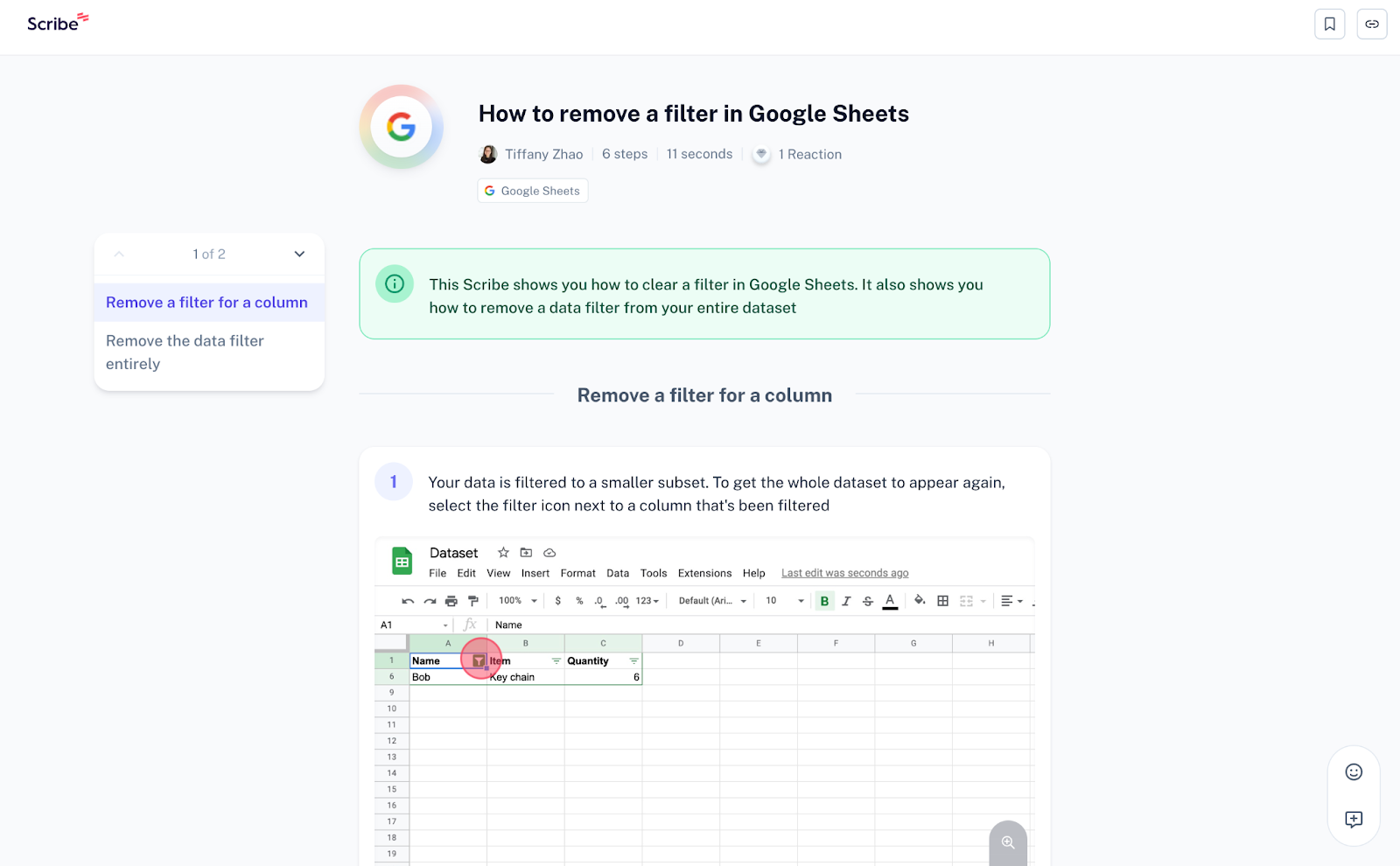
Scribe is an process documentation tool that captures any on-screen process and converts it into a step-by-step guide with annotated screenshots and instructions. It is the opposite of Guidde's video approach. Scribe produces text-and-image documentation that is easy to update, embed, and search.
Where Scribe stands out
- Automatic step-by-step documentation
- Web, desktop, and mobile capture
- Screenshot editing and redaction
- PDF, HTML, and Markdown exports
- Team collaboration and document management
Scribe pricing: The Basic plan is free. Pro Personal costs $25 per seat/month annually or $35 monthly. Pro Team starts at $13 per seat/month annually or $17 monthly, with a five-seat minimum. Enterprise uses custom pricing.
Scribe Pros
- Fast to start recording via browser extension and supports desktop app capture
- Clear post-capture control: shows what was captured and is easy to edit for clarity
- Big time-saver for SOPs and process documentation versus manual screenshots or meetings
Cons
- Capture can be inconsistent: missed clicks/screens, and it may log irrelevant keystrokes
- Too granular by default, which can make guides noisy without cleanup
- Limited control when turning steps into AI GIFs (hard to slow down or emphasize key moments)
Should you use Scribe?
Scribe is excellent if your primary need is internal process documentation. Ops, IT, HR, and L&D teams that need to capture workflows and turn them into SOPs, training guides, and knowledge base articles will love how fast it works. But Scribe does not create anything a prospect would click through. If you need customer-facing demos, sales leave-behinds, or interactive product tours, you will need a different tool entirely.
3. Loom
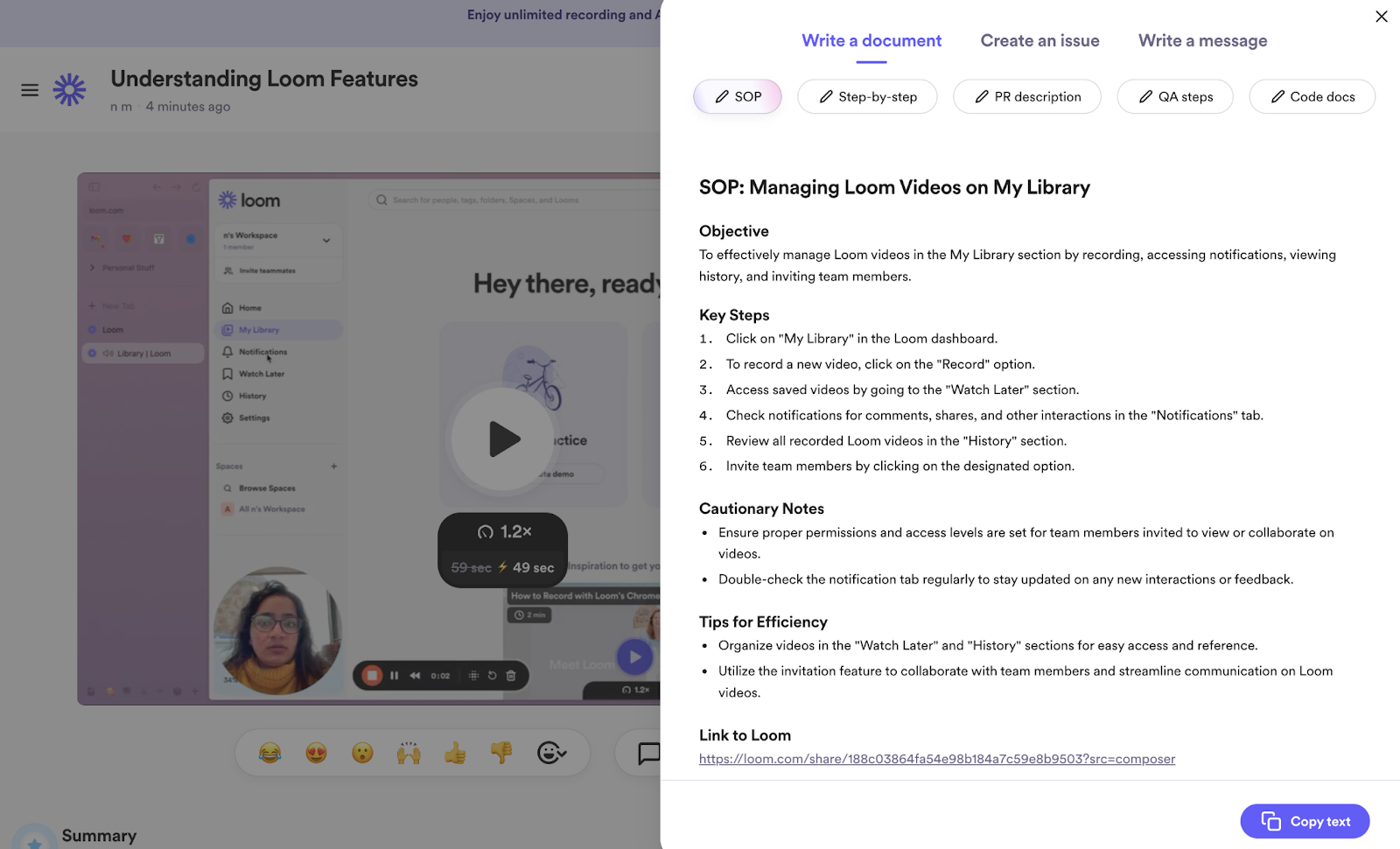
Loom is the go-to video messaging platform for fast screen and webcam recordings. It is not a documentation tool or a demo platform. It is a communication tool that replaces meetings and long email threads with quick video walkthroughs.
Since Atlassian acquired Loom in 2024, the platform has been migrating into Atlassian's billing system, which has affected pricing for some users.
Key features
- Screen and webcam recording: Record your screen, camera, or both simultaneously with one click.
- AI summaries: Loom AI generates transcripts, summaries, and chapters automatically (requires Business + AI plan).
- Comments and reactions: Viewers can leave timestamped comments and emoji reactions on videos.
Loom pricing: Starter is free with 25 videos and five-minute recordings. Business costs $18 per user/month, while Business + AI costs $24 per user/month. Annual
Loom pros
- Very quick way to explain ideas and walkthroughs without meetings
- Simple sharing via link, with viewer insights like watch activity and time watched
- Easy to pick up: clean UI and low learning curve for teams
Loom cons
- Processing can be slow for longer videos
- Editing is limited, and many advanced features sit behind paid plans
- Occasional recording quality issues like lag or audio sync problems, especially when exporting and editing elsewhere
Should you use Loom?
Loom makes sense if your primary need is async video communication, like quick bug reports, feedback recordings, status updates, and one-off tutorials. It is unmatched for speed and simplicity.
But Loom videos go stale fast, are not interactive, and do not work as a scalable knowledge base. If you need structured documentation or demos that prospects can click through, Loom is the wrong category entirely.
4. Tango
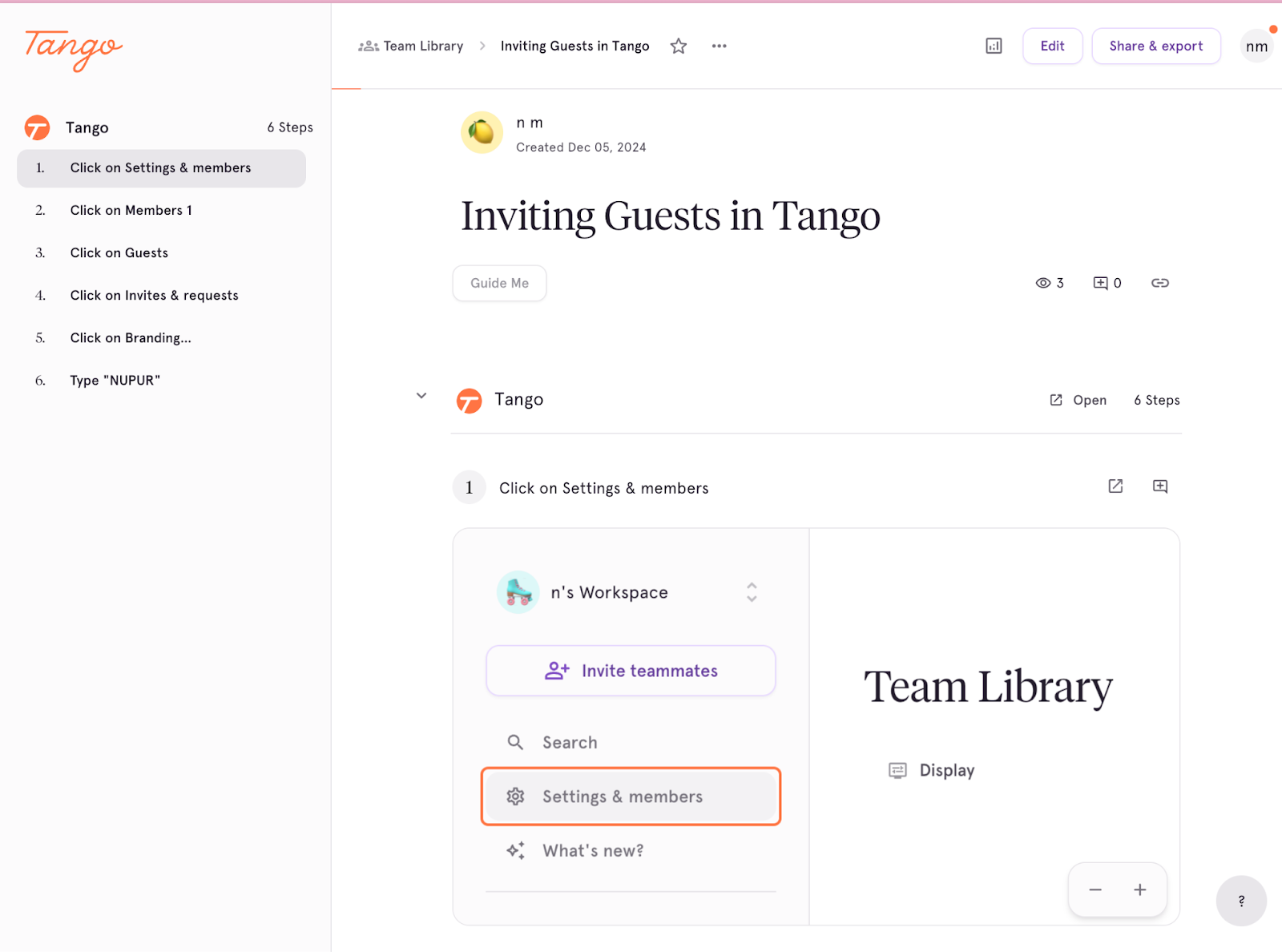
Tango is a user-friendly alternative to Guidde that helps you record, edit, and share quick product walkthroughs. You can use it to create how-to guides, training manuals, and onboarding kits.
Key Tango features
- Demo analytics: The tool gives insights into each walkthrough through metrics like the total number of views, completion rate, and drop-off steps.
- Guide Me: This feature creates a real-time clickable walkthrough that works if the viewer has the Tango extension downloaded.
- Nuggets: You can pin quick guides, tips, or notes on specific clickable elements in the app. This feature lets you add Tango links, text, URLs, and more to offer quick access to relevant information.
Tango pricing: Free includes five shared workflows. Pro Team costs $15 per user/month annually or $20 monthly for teams of three or more. Pro Personal costs $22 per user/month annually or $26 monthly for one to two users. Enterprise pricing is custom.
Tango pros
- Very easy setup with a Chrome extension, and it captures steps quickly in real time without slowing the browser
- Automatically turns workflows into clean step-by-step guides, saving time versus manual screenshots and writing
- Follow Mode adds in-app, step-by-step guidance overlays that make training more hands-on than static docs
Tango cons
- Free plan is restrictive: PDF download is paid, and capture is browser-only so you cannot document desktop app workflows
- Capture and editing can be imperfect: screenshots may miss small details, editing feels clunky, and complex flows can lag
- Limited enterprise readiness for customer-facing use: branding/white-label options are limited, the UI is English-only for some users, and analytics can lack depth for drop-off and impact tracking
Should you use Tango?
Tango is a solid choice for small teams that need quick, no-fuss internal process documentation. It works well for IT help desks, support teams writing how-to articles, and anyone who values simplicity over feature depth.
But its output is functional rather than polished. If you need rich, interactive demos for sales or marketing pages, or if you need desktop capture, Tango will feel limiting quickly.
5. Trainual
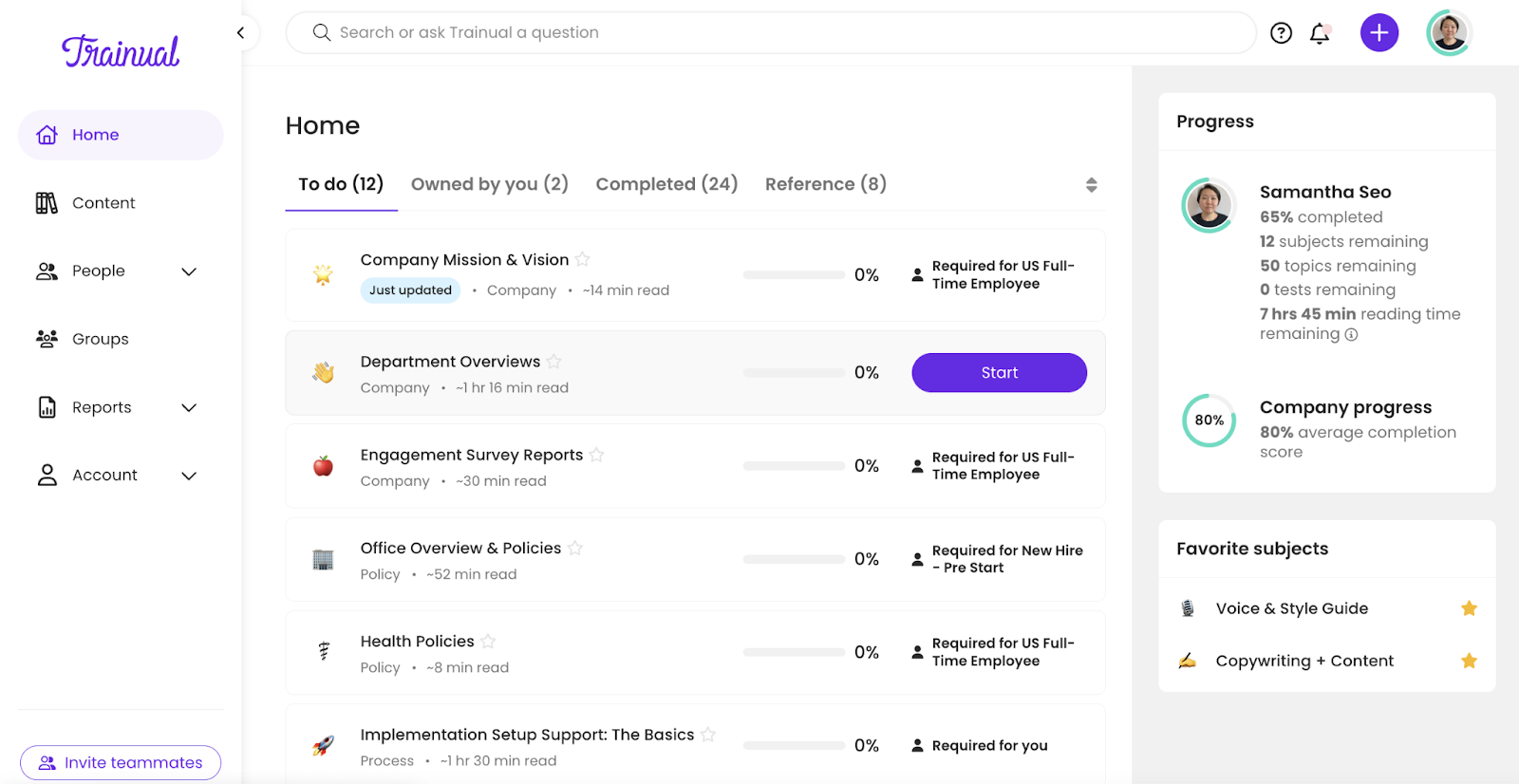
Trainual is fundamentally different from Guidde. It is not a screen recording or demo tool. It is a training and knowledge management platform where you build structured playbooks, onboarding programs, and SOPs with text, embedded media, and quizzes.
It makes the list because some Guidde users are specifically looking for a better way to train employees.
Key Trainual features
- AI-powered documentation: Trainual AI helps draft SOPs and training docs from prompts.
- Role charts: One-click org charts that clarify responsibilities across the company.
- Progress tracking: See who has completed which training modules and where they are stuck.
- Templates: 700+ pre-built templates for policies, processes, and onboarding programs.
Trainual pricing: Trainual does not publish fixed subscription prices. Pricing varies by team size and plan, and every new customer pays a one-time $1,000 implementation fee.
Pros
- Can embed Video, GIFs, and other graphics within documents
- 700+ employee onboarding, training, and SOP templates
- Easy to organize and find training material
Cons
- Integrations are sparse, with heavy reliance on Zapier
- Limited editing features, with formatting being a time consuming task
- Group-based seat and pricing plans aren’t justifiable for smaller team sizes
Should you use Trainual?
Trainual is the right choice if you are a growing company (25 to 500 employees) that needs to systematize onboarding and eliminate tribal knowledge. It is a lifesaver for HR and ops leaders drowning in manual training.
But if you are looking for a Guidde replacement for creating product demos, video docs, or any kind of customer-facing content, Trainual solves a completely different problem.
6. Snagit

Key features of Snagit
- Scrolling capture: capture full web pages, long dashboards, and large spreadsheets in one shot
- Screenshot editing and annotations: arrows, callouts, highlights, blur, stamps, and templates
- Capture library: stores and organizes past captures so you can reuse assets
- Sharing options: export and share files across common formats and channels
Snagit pricing: Individual: $39 per year (subscription)
- Teams and business licensing: available via TechSmith (pricing varies by volume)
Pros
- Best-in-class screenshot capture and annotation tools
- Scrolling capture is especially useful for documentation
- Easy to create consistent, step-by-step visuals across a team
- Simple learning curve
Cons
- Not interactive. Output is images and videos, not click-through demos
- Video editing is limited compared to dedicated video editors
- Better for documentation than customer-facing product experiences
Should you use Snagit?
Use Snagit if your main goal is creating clear screenshots and visual SOPs quickly, especially for support, internal enablement, and process documentation. If you need a hands-on product experience where prospects or customers can click through a flow, you will want an interactive demo platform instead.
7. Storylane
Key features of Storylane
- Multi-format demos: build demos using screenshots, video, or HTML capture (HTML typically starts on higher tiers).
- Lily AI: assists with demo copy, voiceovers, translations, avatars, and can help generate tours from recordings.
- Account reveal: attempts to identify anonymous visitors and attach company-level data (plan dependent).
Storylane Pricing
Storylane's pricing: Free supports one published demo. Starter begins at $40 per seat/month. Growth costs $500/month annually for five seats and unlocks HTML demos. Premium costs $1,200/month annually for 10 seats and adds Hubs, Deal Intelligence, SSO, Salesforce, and offline demos. Sandbox demos require Enterprise.
Storylane pros
- Simple, intuitive UI that makes it fast to create and update interactive tours as your product changes
- Strong workflow for replacing static docs with click-through demos for proposals, help centers, and customer education
- Responsive support and an active product team that ships improvements based on customer feedback
Storylane cons
- Mobile experience is limited since tours are primarily designed for desktop viewing
- Pricing jumps between tiers, especially if you need HTML capture/features
- Editing and asset management can be clunky at scale (lag on larger projects, slow downloads, no bulk delete, and no recovery for deleted items)
Should you use Storylane?
Storylane is a capable choice for mid-market and enterprise B2B sales teams that have the budget for a dedicated demo platform and need HTML-captured product replicas.
But pricing is the sticking point. The 5-seat minimum and $500 per month Growth floor make it expensive for smaller teams, and key features like sandbox demos sit behind the $1,200+ Premium tier.
If you need similar interactive demo capabilities with more pricing flexibility and no forced seat minimums, Supademo offers better value for most team sizes.
Why do customers look for Guidde alternatives?
The video-based documentation platform is useful for creating short, linear how-to videos but lacks the advanced features offered by other interactive walkthrough platforms.
Furthermore, Guidde is typically used as an internal tool and may not be the best fit if you want a full on-brand interactive demo experience that you want to share with customers or external viewers.
Here are why most users look for Guidde alternatives.
Reason #1: Lacks advanced video editing features
Guidde's editing toolkit covers the basics like background color changes, font adjustments, and motion additions. But it lacks personalization, zoom and pan, sensitive information redaction (on free and Pro tiers), speed adjustment, and cropping. You end up relying on external tools, which adds cost and friction.
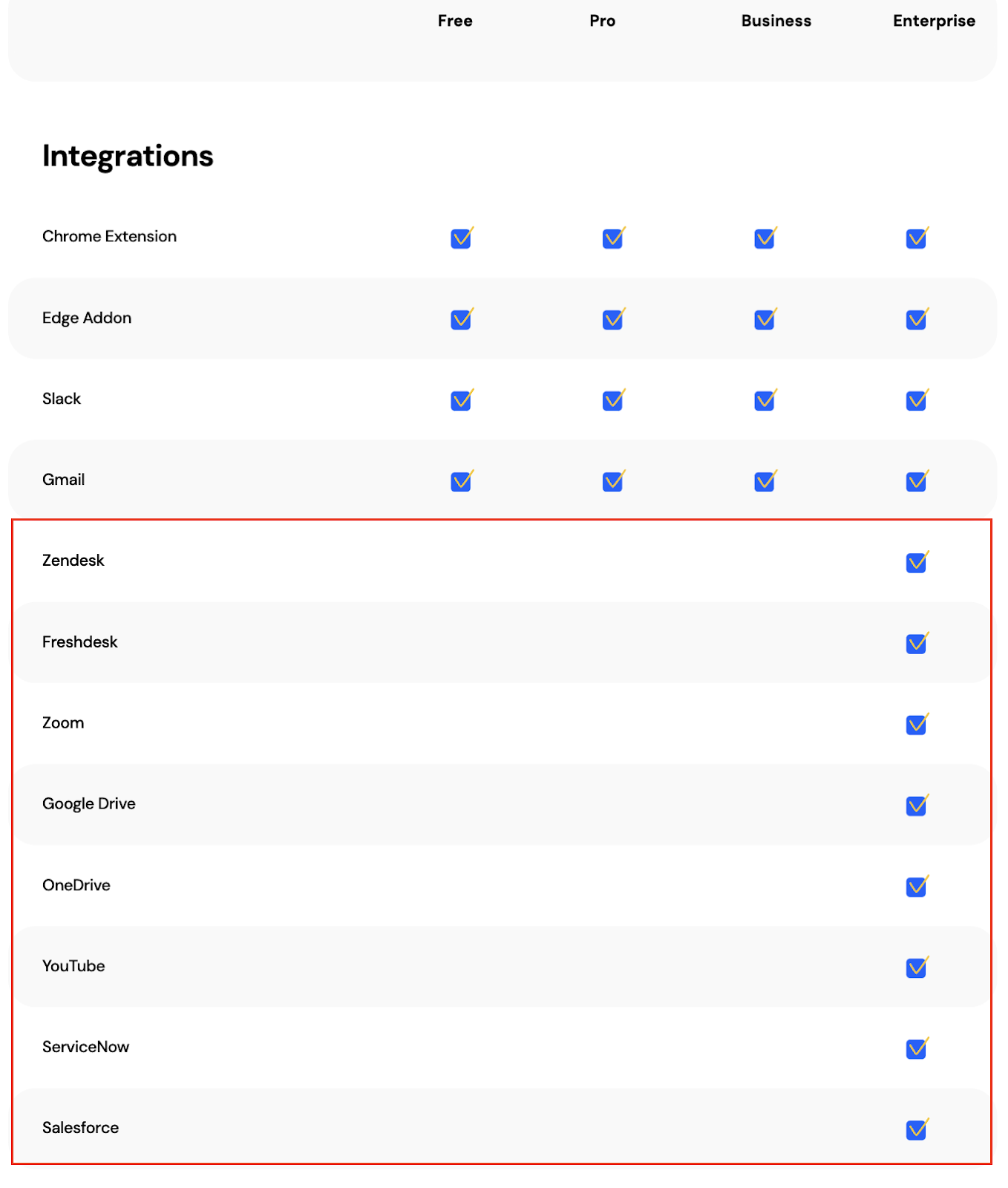
Reason #2: Limited number of integrations
Guidde integrates with a limited app (only 12), leading to manual data transfer, which is time-consuming and can slow down the knowledge transfer.
Also, key integrations like Salesforce, Zoom, Freshdesk, and ServiceNow are locked to Enterprise plans. On Pro, you only get Slack and Gmail.
Such gated access to integration can end up eating much of your budget and make the documentation creation process cumbersome.
Reason #3: Limits you to 100 steps per video
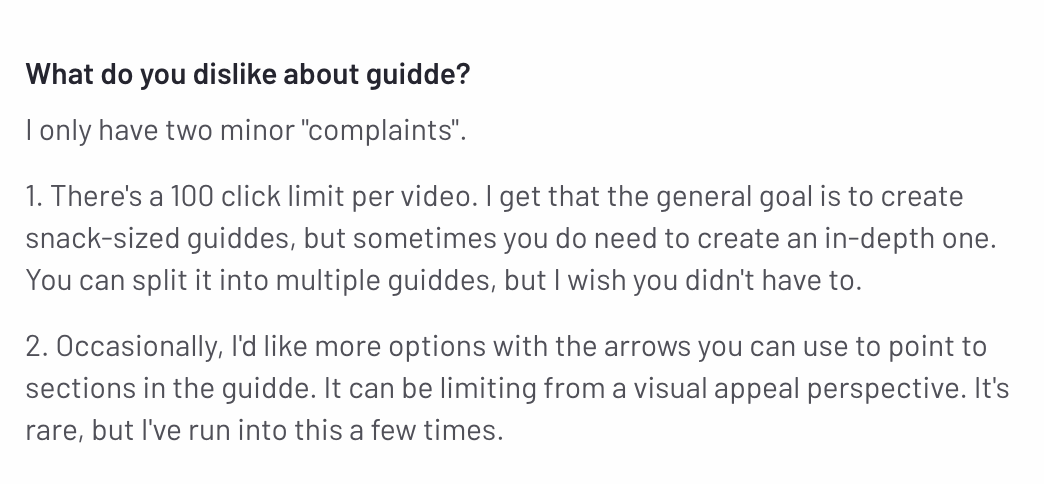
You cannot create videos with more than 100 steps. For complex technical walkthroughs or multi-stage onboarding flows, this means splitting content into multiple clips, which creates information overload and a disjointed viewer experience.
After testing out the tool, we also found that the recorded output takes too long to generate. There was also a lag in the video editing feature, especially when you save it after making a few changes.
Reason #4: Too much manual cleanup for client-ready content
According to recent user reviews, Guidde can take longer than expected when you need polished, customer-facing output. Users mention spending extra time personalizing content and fixing AI-generated suggestions that are not consistently accurate, which reduces the efficiency gains teams expect from an AI video tool.
"...the AI component of Guidde is sometimes not smart enough, which affects efficiency. Furthermore, while the initial setup by adding a browser extension and getting an account is easy, the setup process lacks clarity, especially regarding account levels when not being an administrator..." - G2 User Review
Frequently Asked Questions about Guidde alternatives
Commonly asked questions about this topic.
Which Guidde competitor offers the best video demo capabilities?
How does Supademo compare to Guidde?
What are the main reasons teams migrate from Guidde to other platforms?
Which Supademo features provide advantages over Guidde's toolset?
Can I use Supademo without paying if I'm switching from Guidde?
What should I look for when evaluating a Guidde alternative in 2026?
What is the best Guidde alternative for interactive product demos?
What is the best free Guidde alternative?
Ready to replace Guidde to create high-performing interactive demos?
If you have outgrown Guidde's video-only documentation, Supademo gives you everything it does not: multi-format interactive demos, AI-powered editing, deep personalization, demo hubs, and robust analytics. And unlike most alternatives, you do not need to commit to enterprise pricing or forced seat minimums to access the features that matter.
Whether you are in sales, marketing, customer success, or product, Supademo is the fastest way to go from static Guidde videos to interactive demos that actually convert.
Try Supademo for free or request a personalized demo to see how it works for your team.

Content Specialist
Nupur is a content writer with 3+ years of experience writing for SaaS startups and agencies. Her expertise lies in writing customer-centric content.

Content Marketer
Content marketer with 3 years of experience helping B2B SaaS companies grow through SEO-driven content. Skilled in creating blogs, thought leadership, and product-led growth assets across sales, AI, IT, HR, and digital transformation.